Finding the productbehind the AI

Finding theproduct behindthe AI

Aroura AI is an early-stage startup in London, one of 24 selected for the AI Forge incubator out of more than 500 startups. I designed a K-Beauty discovery platform connecting personalised recommendations for UK consumers with aggregated market learning for Korean brands. Across three product directions, I reframed the opportunity from AI-powered discovery alone to an exchange that could create value for both consumers and brands. Our team tested that direction through two London pop-ups, and I translated the consumer and brand needs I found there into this new product model.

TEAM2 FOUNDERS · PRODUCT + BRAND DESIGN · ~3 ENGINEERS
ROLESOLE PRODUCT DESIGNER
TIMELINEAPR 2025 - JUL 2026
Background

Two pivots, then K-Beauty

Aroura AI went through two earlier products before the K-Beauty recommender this case study develops. Each attempt exposed a different constraint and narrowed what the next product needed to prove.

01
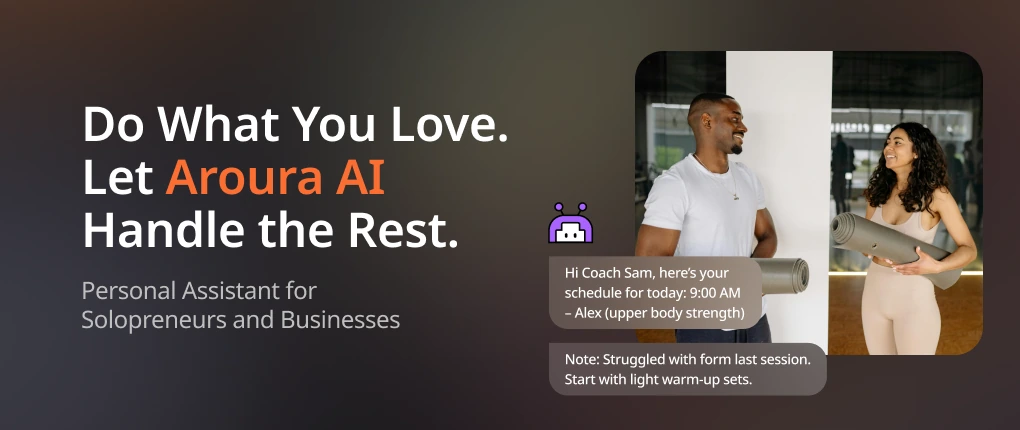
The AI coach automation product: scheduling and client admin handled by an assistant.

AI coach automation

The problemCoaches were running a business across three apps. Clients found them on Instagram, asked their questions in DMs, then moved to iMessage or WhatsApp to agree a time. Nothing was in one place and no booking was searchable.What we builtAn AI assistant that handled the workflow end to end: responding to enquiries, turning conversations into bookings, sending reminders and session follow-ups, and keeping the client record up to date.Where it stoppedEvery one of them ran the business differently. Notes on paper, their own discount packages, their own way of keeping up with a client. There was no shared shape to the work and no structured record of it to learn from, so the assistant could only ever be a generic one.What I took from itReliable automation needs structured operational data underneath it, and this domain had none to give us.
02
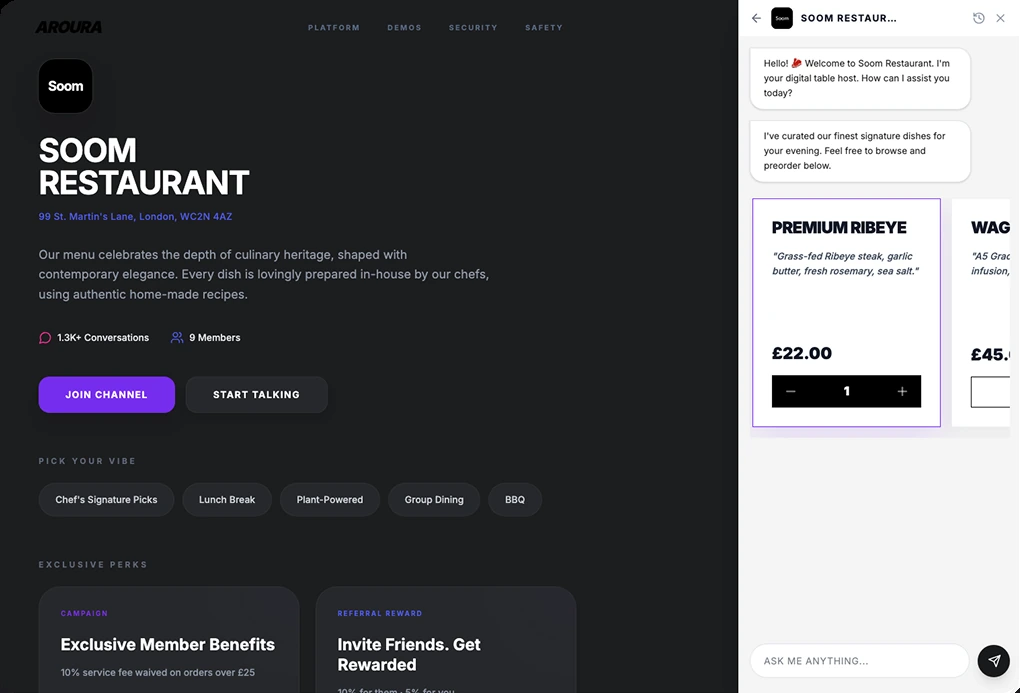
The restaurant AI: an assistant reading an unfamiliar menu with the diner.

Restaurant AI

The problemLondon has one of the most diverse food scenes in the world, and the ones people want to try are the hardest to walk into. So a table gets booked days ahead, often before anyone has seen the menu, at a cuisine they may not know. What is this dish, is it safe with my allergy, and how much do we order for six.What we builtAn assistant that read the menu with them and took the booking: what each dish is, what is in it, what to avoid, and how much of it a table that size should order.Where it stoppedThe consumer problem was real, but the business problem was not. Restaurants asked why they would pay a booking commission for something the customer would have done through Google Maps or their own website anyway.What I took from itA useful experience is not automatically a viable product. From that point on, I evaluated ideas from both sides: whether they created meaningful value for users, and whether there was a clear customer willing to fund that value.

03
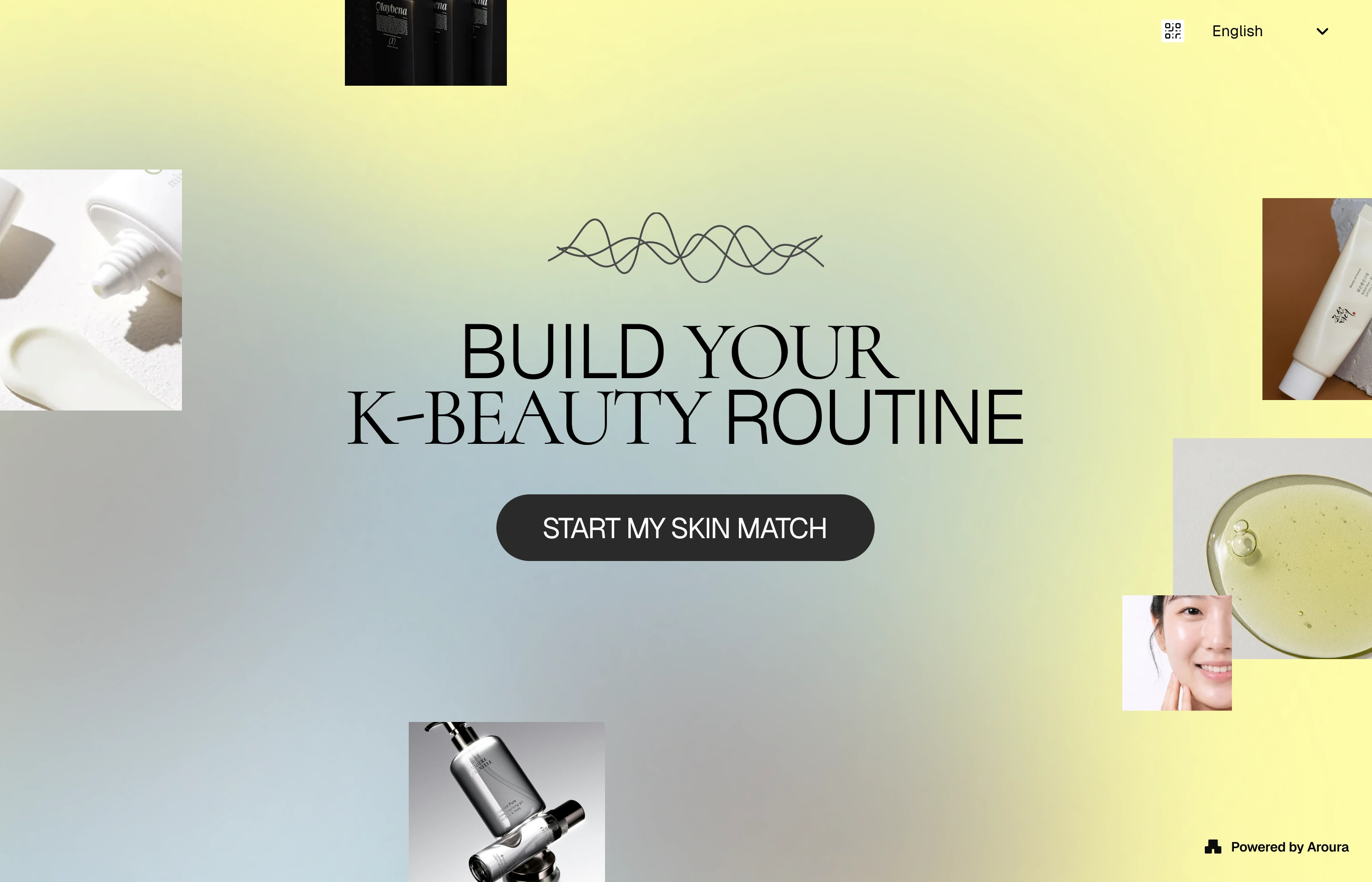
The first K-Beauty recommender: a skin profile in, matching products out.

K-Beauty recommendation

We built an AI recommender to help UK consumers navigate K-Beauty, but the business model remained unresolved.

One recommendation, two kinds of value

The product model I arrived at after the fieldwork: relevant, explained recommendations for consumers, with aggregated UK market learning for participating brands.

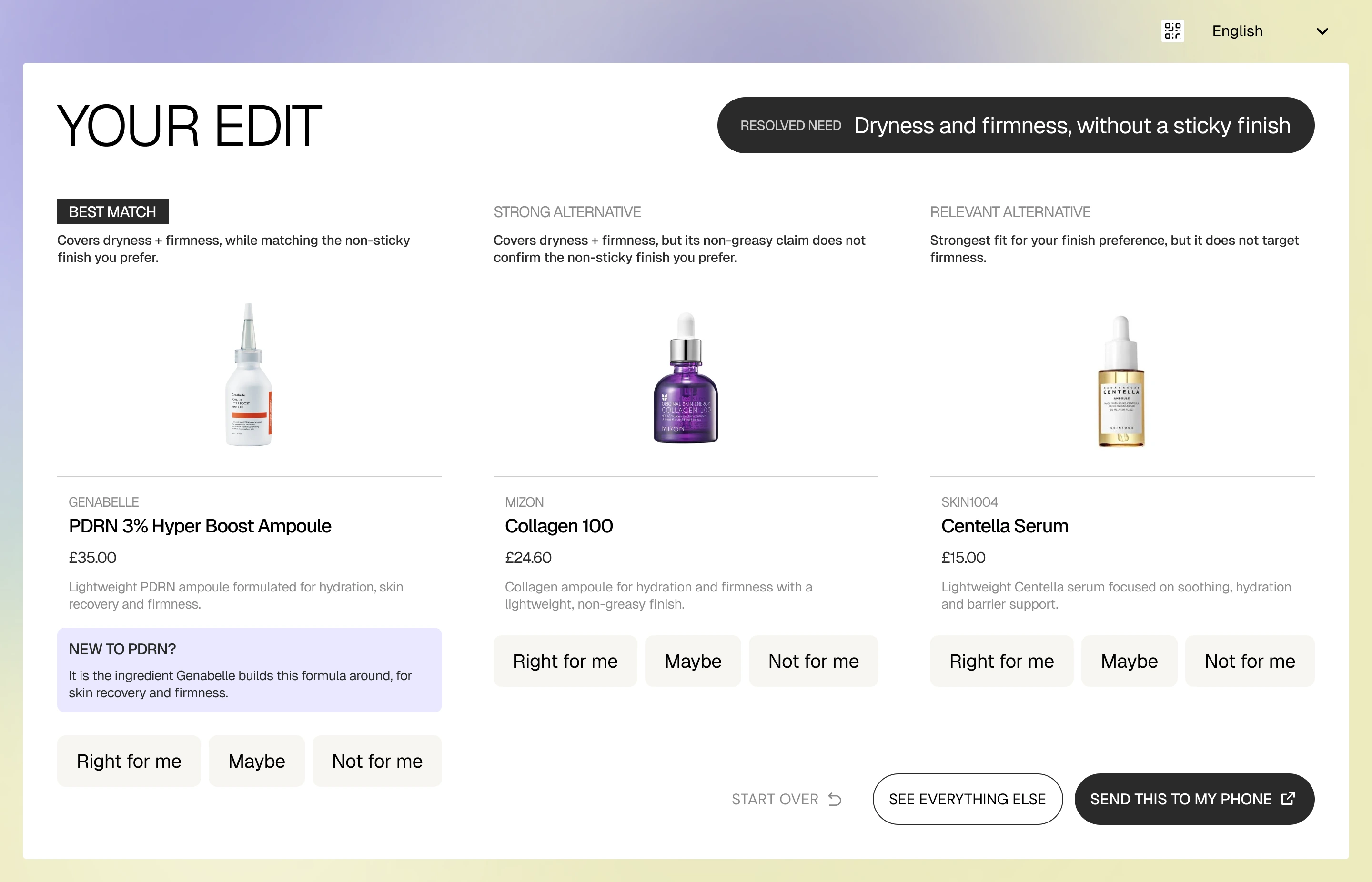
ConsumerEach recommendation carries the reason it is there
The consumer result screen: recommended products, each carrying the reason it was chosen
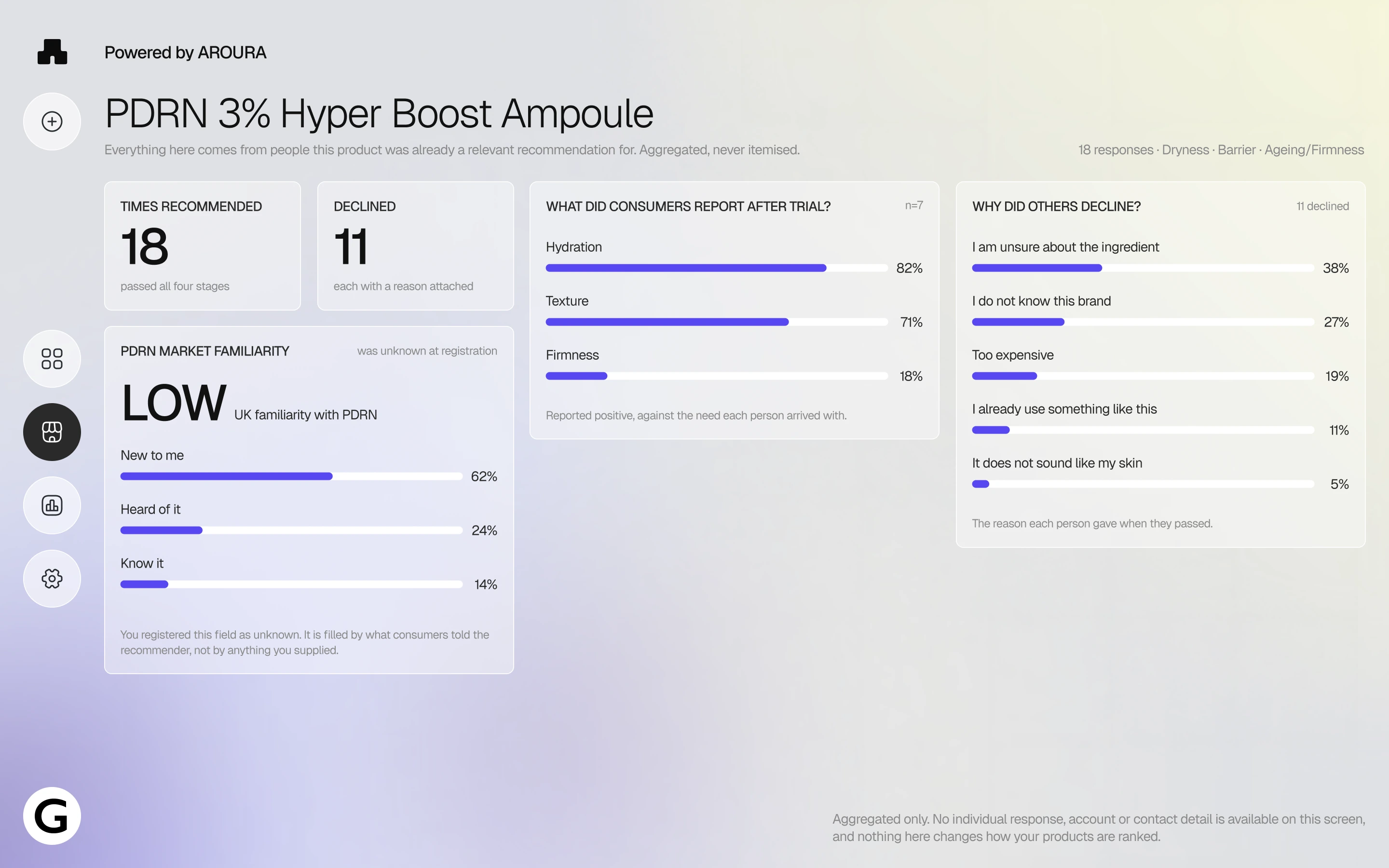
BrandHow relevant consumers responded, in aggregate
The brand dashboard: aggregated patterns in how consumers responded to the product
ConsumerShares context
  • Skin and sensitivity
  • Current need
  • Product experience
shares relevant contextreceives clearer guidance
Aroura AITurns context into relevant discovery
  • Explained recommendations
  • Structured response
provides products and research goalsreceives aggregated patterns
BrandLearns from response in aggregate
  • Needs and interest
  • Purchase barriers
  • Post-trial patterns

This was the proposed value exchange. The research below explains how I got there and what still needed commercial validation.

HOW I GOT THERE

The product came last. I started with the market.

Before designing the new model, I examined both sides of the exchange: what UK consumers were actually stuck on, and what Korean brands could not see about the market they were entering.

01 · Demand

K-Beauty had already entered the mainstream

UK market
+65%K-Beauty sales by value, year to March 2026
Boots
K-Beauty sales in one year
Boots
1 every 11 secKorean skincare product sold

The first problem was not convincing UK consumers that K-Beauty was worth buying. Demand was already growing.

Cosmetics BusinessBoots Beauty & Wellness Trends Report 2026
02 · Availability

Finding K-Beauty was becoming the easy part

Pureseoul
70+ brands~2,000 Korean beauty SKUs
Skin Cupid
60+ brandsAt its London flagship
Boots / Superdrug
Mainstream retailK-Beauty assortments expanding

Retailers were solving availability at speed. More brands were becoming easier to find, online and in-store. But more access also meant more to choose between.

Vogue BusinessSkin CupidBoots Beauty & Wellness Trends Report 2026
03 · Access ≠ decision

Access did not end the decision journey

Consumers weren’t only searching for products. Across generations, product reviews ranked among the leading skincare search interests, alongside ingredients, treatments, routines and practical advice.

And that search was already omnichannel. UK skincare discovery stretched across Google, YouTube, Instagram and TikTok rather than a single source of information.

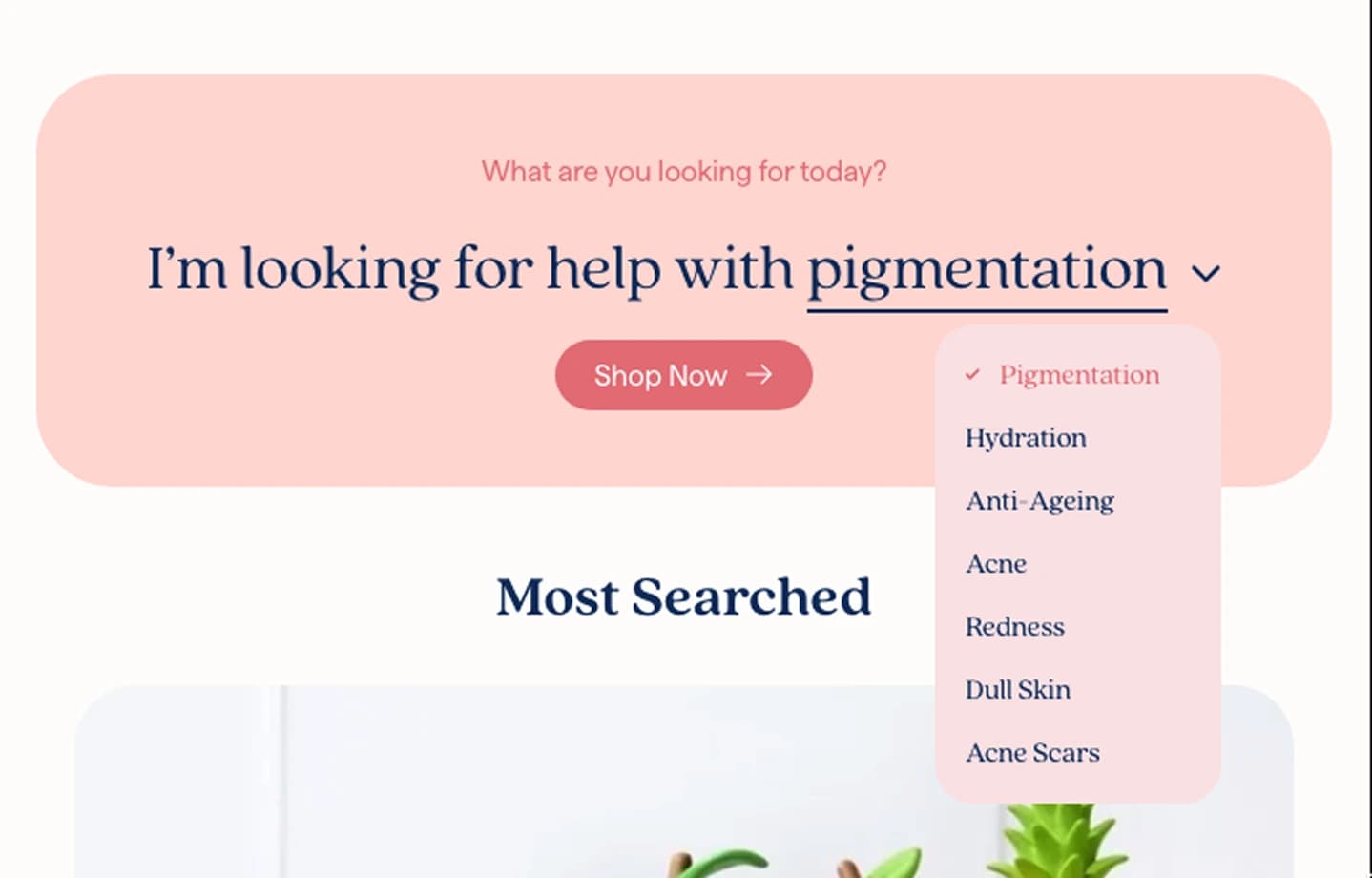
Retailers were already responding with concern-led discovery and guidance.
Skin Cupid's concern-led product navigation, helping shoppers browse Korean skincare by the needs relevant to them.
Skin Cupid organises its catalogue around consumer concerns and guided discovery.

Retailers were already adding filters, curation and human guidance around the products. The problem was not a lack of information altogether. It was turning a rapidly expanding catalogue into a confident personal decision.

Finding a product was only part of the decision. For AROURA, the opportunity was to bring relevant product context closer to the moment of choice.

Greenpark, The Search for BeautyThe StandardSkin Cupid, About us
What the research changed

The gap wasn't awareness.
It was confidence.

UK consumers increasingly knew K-Beauty and could access more of it. But greater choice created a different problem: understanding what was relevant to their own skin, routine and preferences.

“Can I find K-Beauty?”Increasingly, yes.
“Which of these is right for me?”Still unresolved.
01 · The UK was opening up

The UK was opening up to Korean brands

Boots
25+ brandsKorean brands stocked by 2026
Beauty of Joseon
~700 storesBoots locations across Britain
Superdrug
K-Beauty expansionMore Korean brands entering mainstream retail

K-Beauty was no longer entering the UK through specialist retailers alone. Korean brands were expanding across Boots, Superdrug and major online channels, making mainstream distribution increasingly possible.

Getting into UK retail was becoming increasingly possible.

Boots Beauty & Wellness Trends Report 2026Korea JoongAng DailyTheIndustry.beauty
02 · Entering ≠ translating

What worked in Korea did not automatically translate

“The trends happening in Korea are not always the trends happening here.”

Gracie Tullio · Co-founder, Pureseoul

As Pureseoul grew from retailer to market adviser, it saw a recurring localisation gap. Products successful at home could arrive in Britain with messaging, terminology, ingredients or formats that did not carry the same meaning for UK consumers.

Pureseoul described education as one of the biggest challenges of introducing Korean brands to the UK, from adapting claims and formulations to translating familiar Korean beauty terminology such as “emulsion.”

🇰🇷 KoreaNovelty can sell.

Being new can itself be a marketing point.

🇬🇧 UKTrust takes longer.

Being tried, tested and well-reviewed carries more weight.

Entering the market did not mean the product story entered with it.

BeautyMatterTheIndustry.beautyThe Korea Times
03 · Different clocks

The two markets were not moving at the same pace

~5 yearsEstimated lag in UK trend adoption compared with Korea

Pureseoul estimated that British beauty trends can trail Korea by roughly five years. For example, in Korea, PDRN had already passed through its peak. In the UK, it was only beginning to gain traction.

As Pureseoul Co-founder Gracie Tullio noted, “People think this is the peak, but Korea has already gone through eight or ten trends since then.”

🇰🇷 KoreaPDRN already established

Market moving on.

🇬🇧 UKPDRN gaining traction

Familiarity still forming.

The lag creates an awkward problem for Korean brands: by the time UK consumers begin to understand a product or ingredient, the brand may already be changing how it talks about it at home.

A brand could know exactly how to sell a product at home and still not know which part of that story would make sense in the UK.

The Korea TimesBeautyMatter
What the research changed

The gap wasn’t market entry.
It was market understanding.

The desk research showed me that market entry and market understanding were different problems. Korean brands had more routes into the market, but what worked at home did not necessarily translate once they arrived.

“Can I reach UK consumers?”Increasingly, yes.
“Do I know what will resonate with them?”Still unresolved.
NEXT · INTO THE MARKET

Research showed us the gaps. But the product needed participation.

We needed to get into the market: build relationships with Korean brands, see how UK consumers responded, and learn from the interactions between them.

Fieldwork

We took the product into the market through pop-ups.

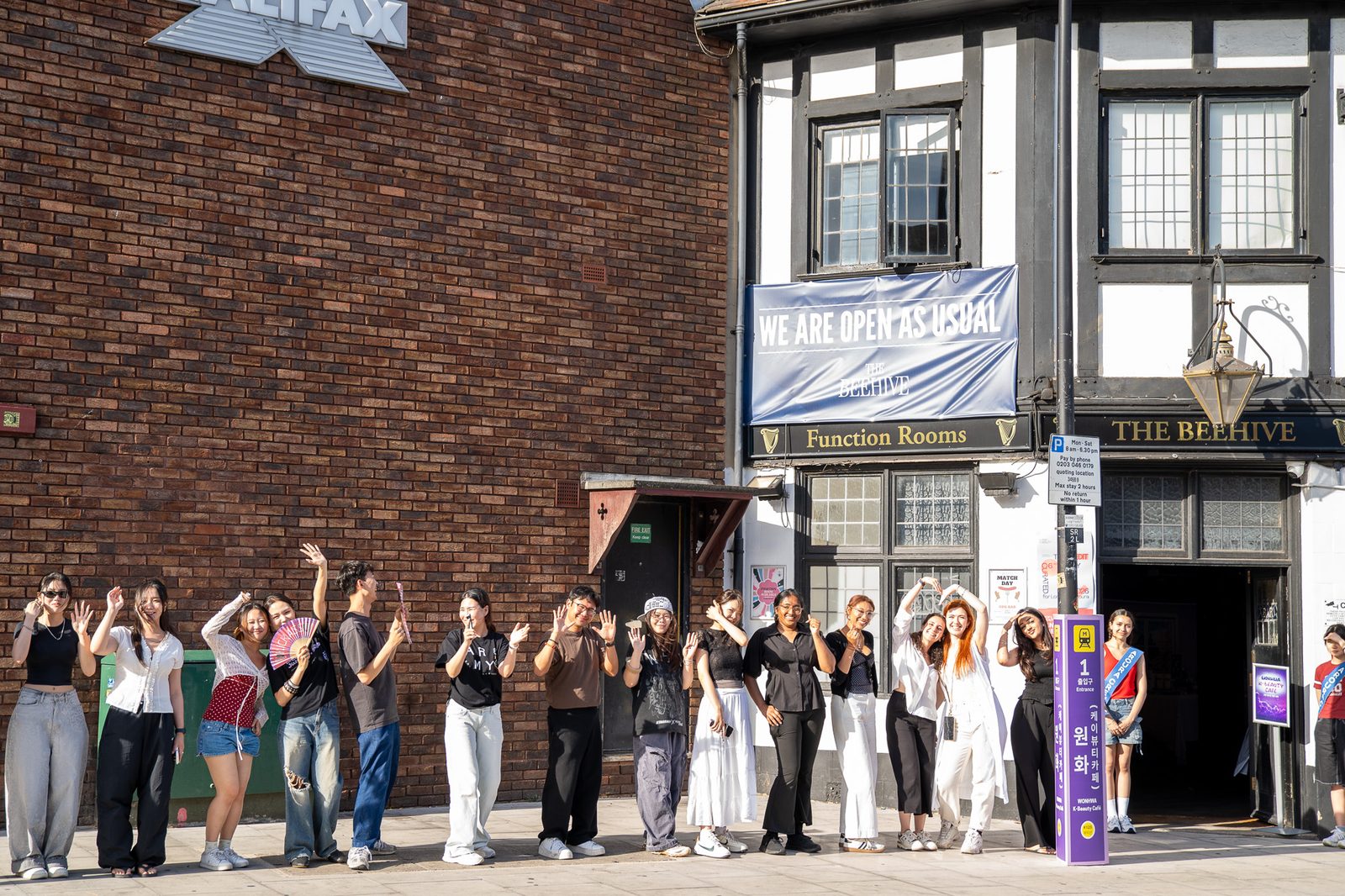
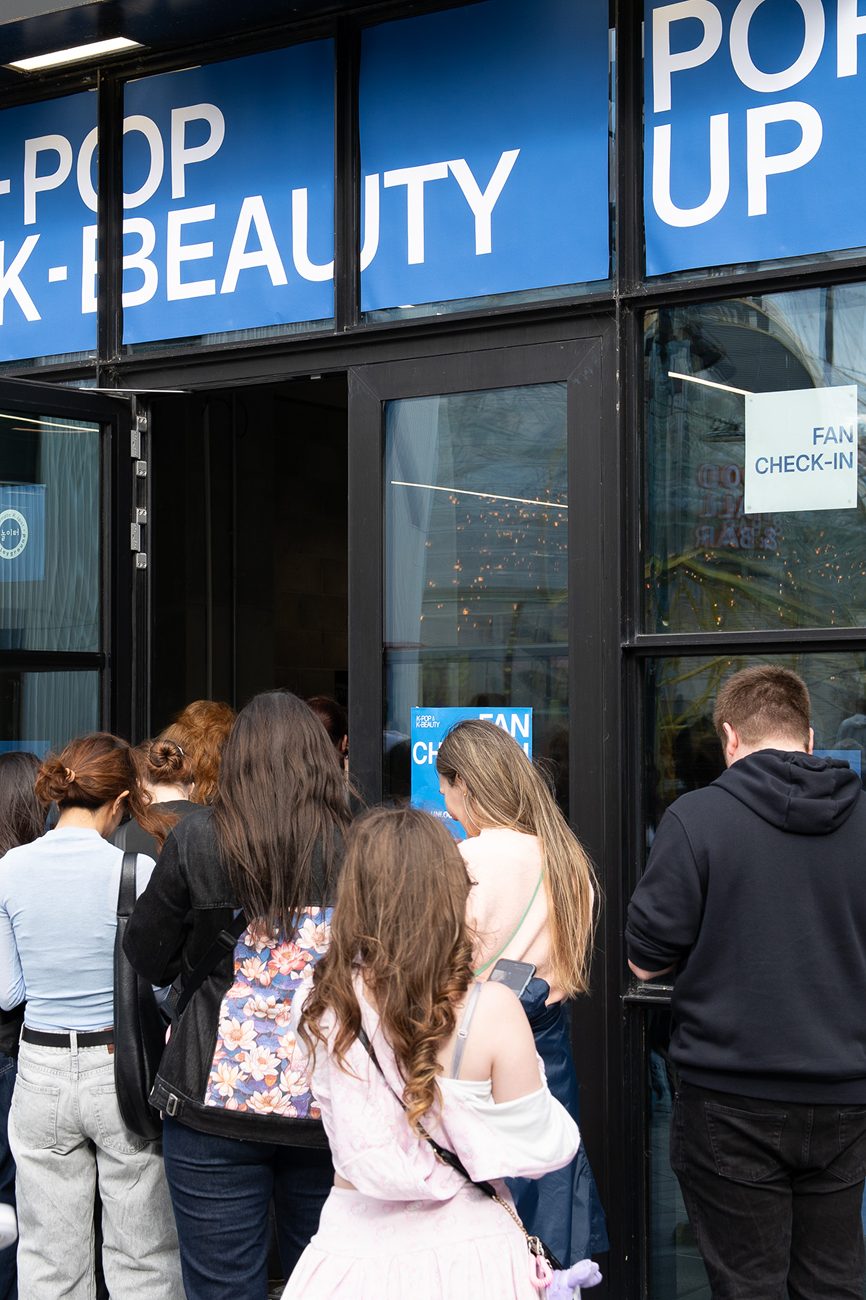
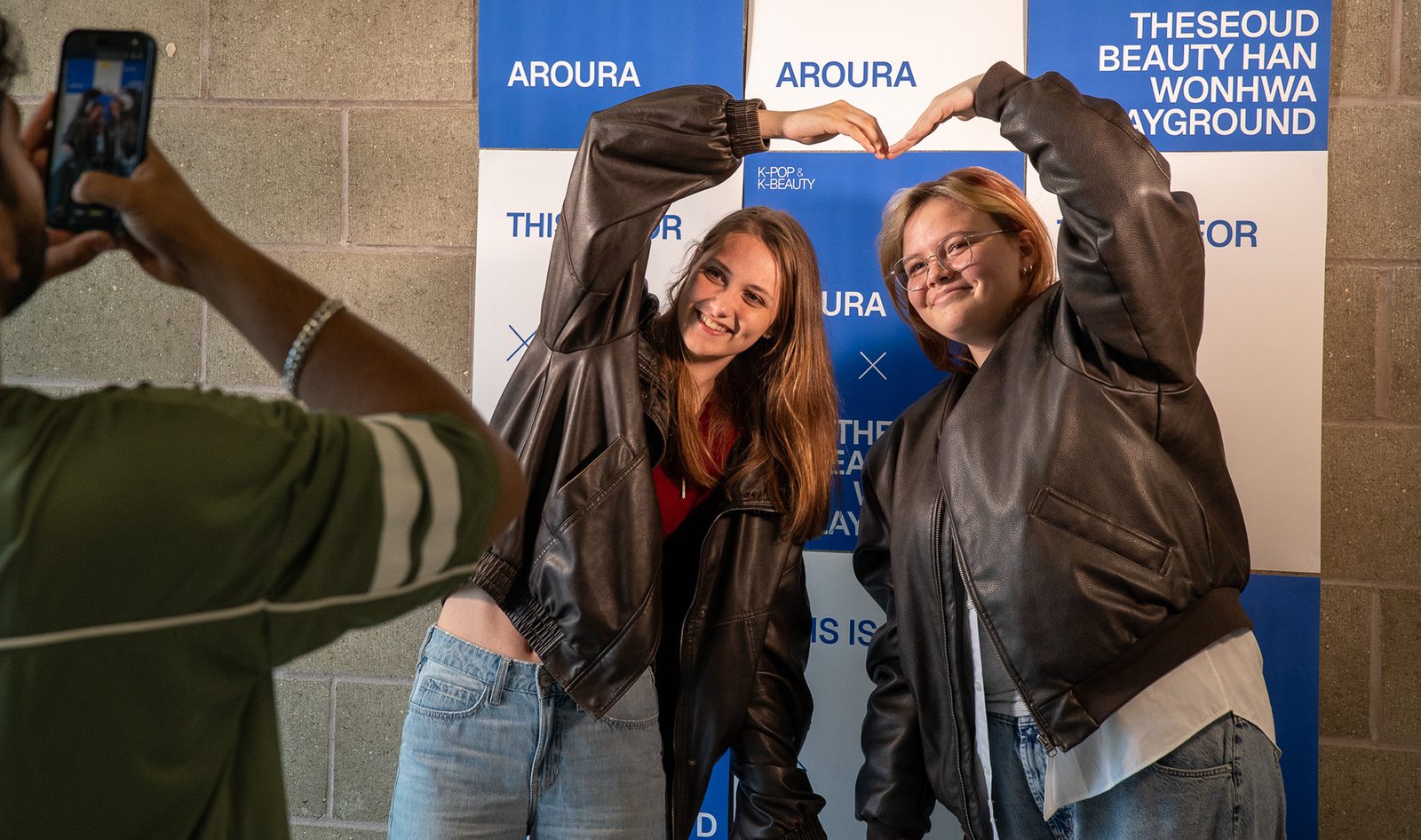
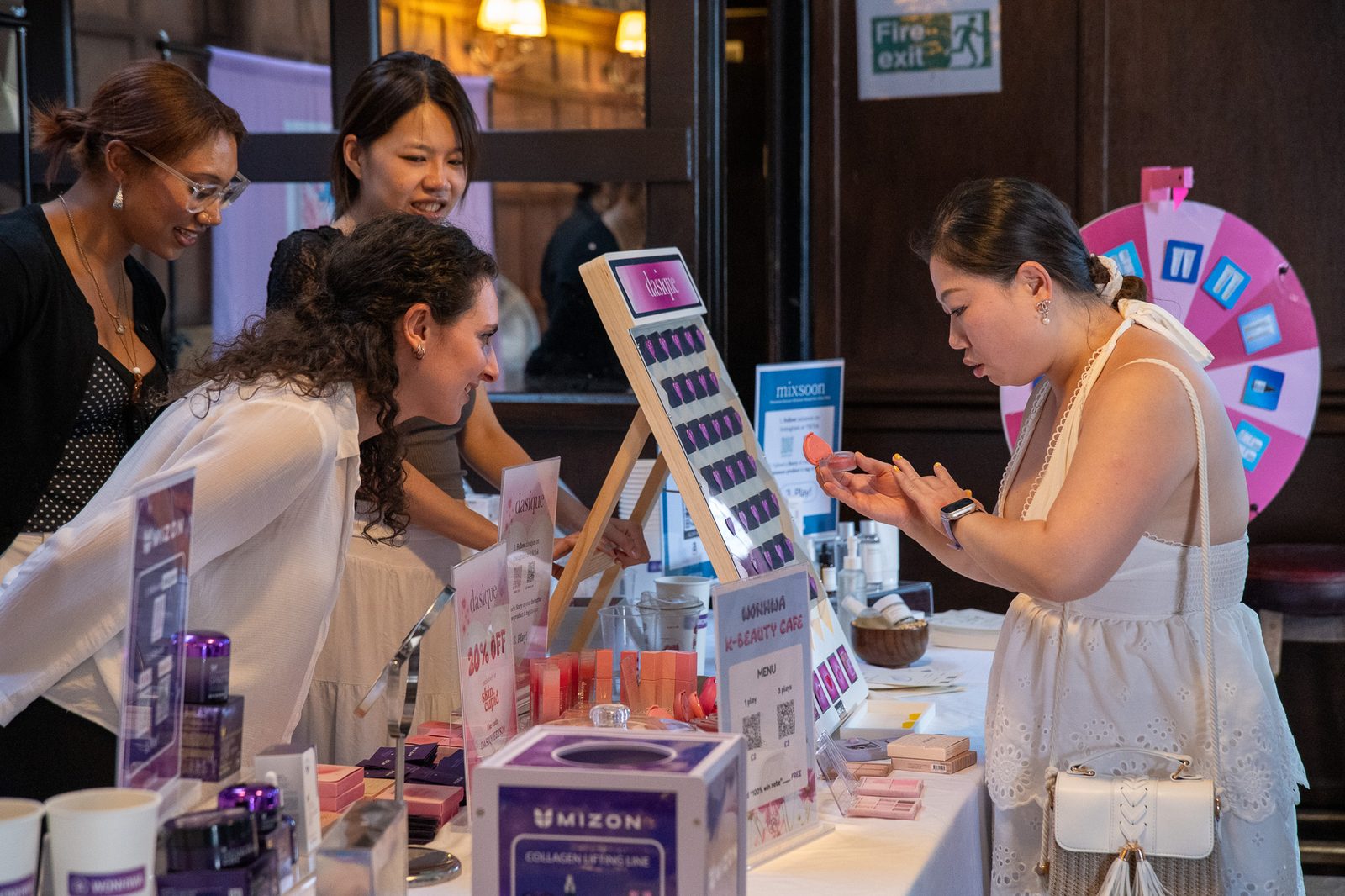
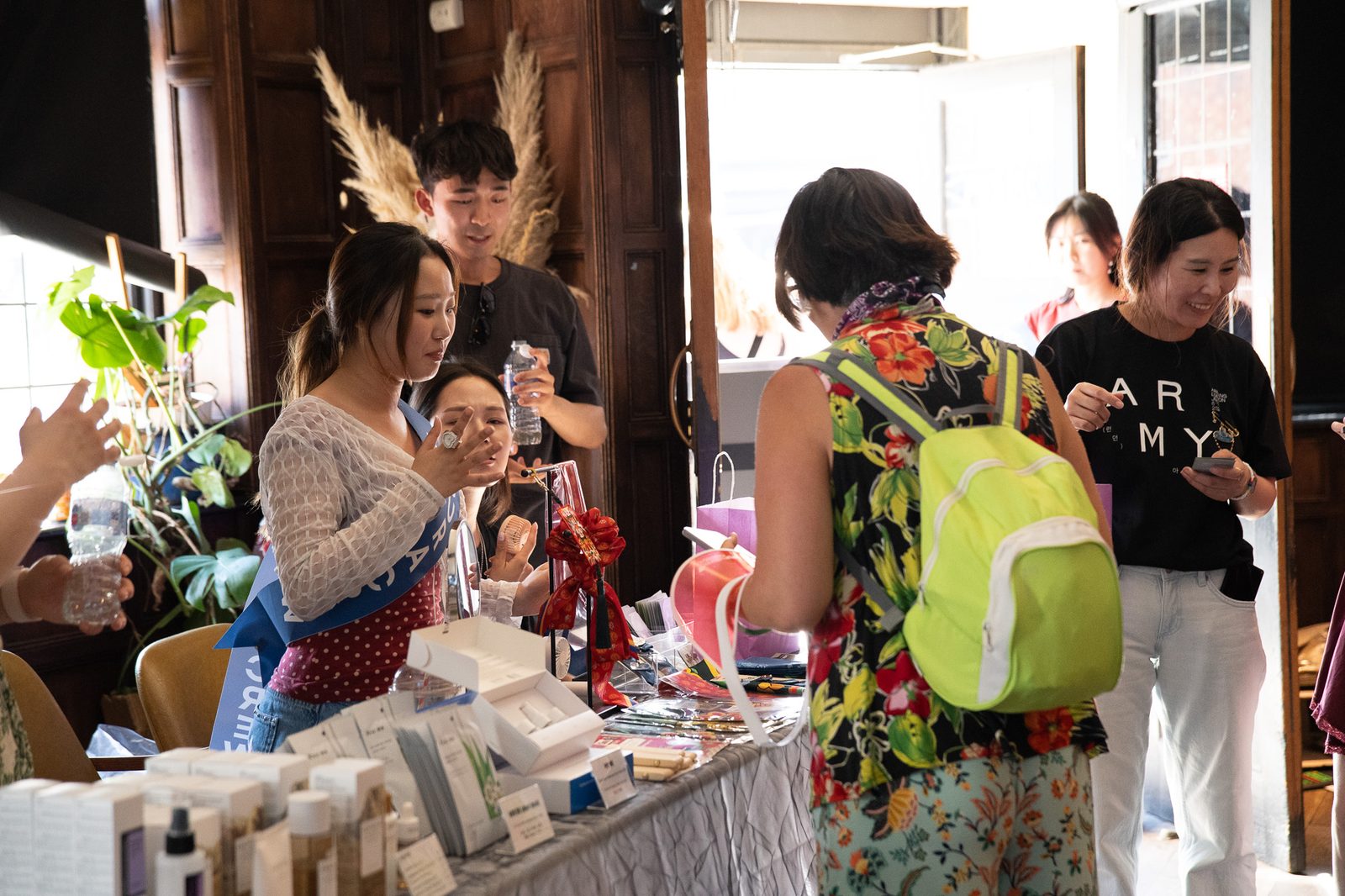
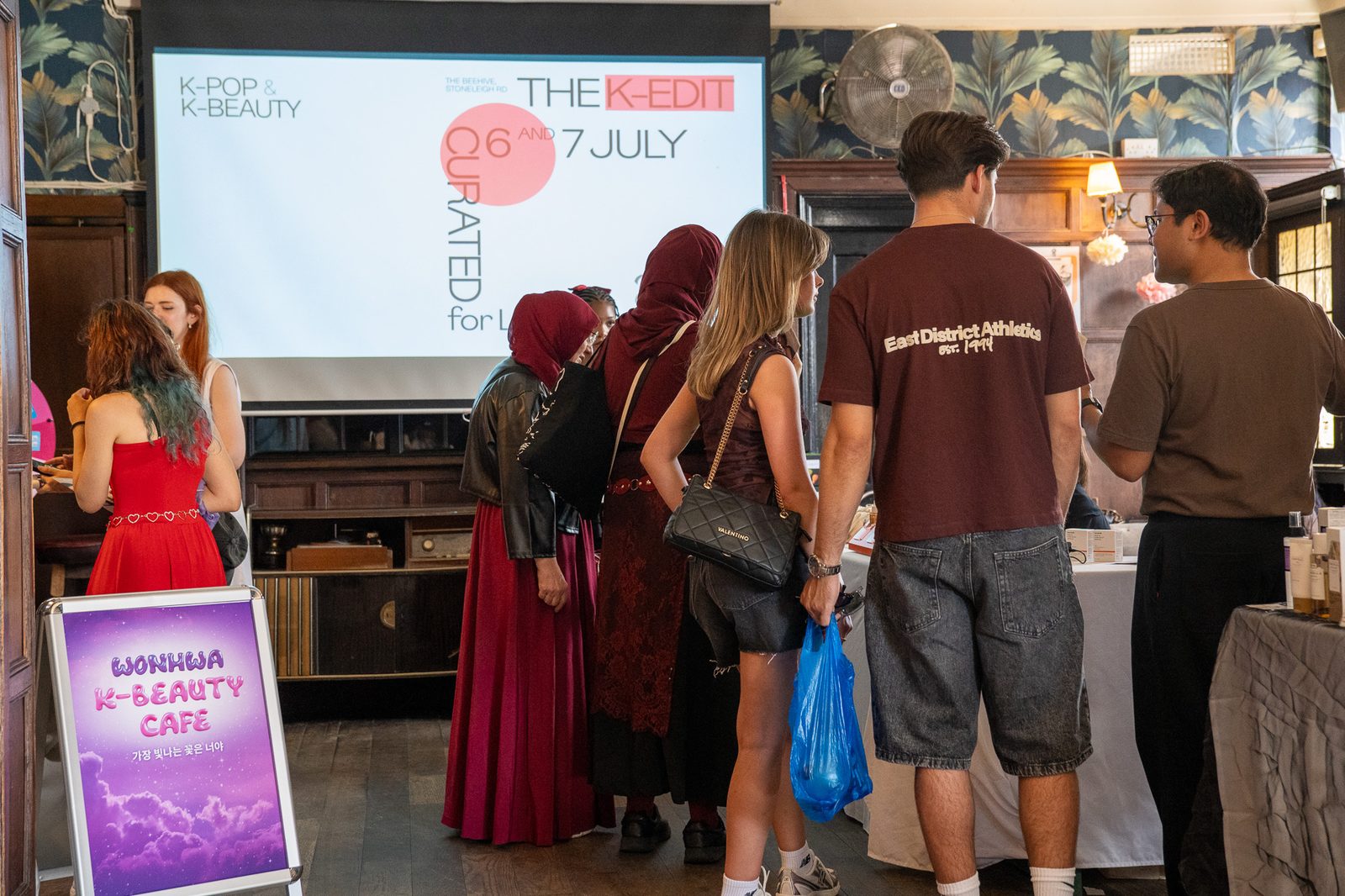
We ran two London pop-ups around the TWICE and BTS concerts, on 3–4 June and 6–7 July. As a team, we brought participating brands together and created opportunities for product discovery, sampling, sales and direct interaction with UK consumers.
Visitors lined up along the street outside the pop-up venue in London.
Visitors queueing at the fan check-in desk inside the K-POP K-BEAUTY pop-up entrance.
Two attendees posing in front of the Aroura AI backdrop.
Visitors trying products at a brand table stocked with samples.
A sampling counter laid out with K-Beauty products as visitors browse.
Attendees gathered in front of the event screen during the K-pop programme.
2500+
People reached through the pop-ups
20K+
Product samples distributed
42%
Asked to hear from us again
84.1K
Organic views across Instagram & TikTok
MY ROLE

I led the consumer-facing social content, contributed to the event format and sampling experience, and designed the printed materials. The content generated 84.1K organic views across Instagram and TikTok.

HOW I USED IT AS RESEARCH

After each event, I synthesised team debriefs, recurring consumer questions and brand feedback across both pop-ups. These became the field insights I used to examine the problem from both sides.

01 · Decision support

A little explanation was often enough to unlock a decision

Visitors often hesitated over unfamiliar products until someone explained the ingredient, benefit or who the product suited. Once that context was provided, the conversation frequently moved quickly toward a decision.

The barrier was not always lack of interest. Sometimes it was one missing piece of context.

02 · Product experience

Trying an unfamiliar product changed the questions people asked

Sampling moved visitors from abstract curiosity to specific evaluation. Once a product was in their hands, questions shifted toward ingredients, benefits, texture, suitability and whether it matched their own concerns.

Experience turned generic interest into personal feedback.

03 · Trust & familiarity

Familiarity shortened the path to purchase

Visitors who already recognised brands such as SKIN1004 or Arocell often made faster purchase decisions. Unfamiliar brands required more sampling, explanation or reassurance before consumers could evaluate them.

Recognition created confidence. Unknown brands needed context before consumers could evaluate them on equal terms.

What the fieldwork changed

Consumers needed enough context to choose

Fieldwork made the earlier confidence gap more concrete. Familiar products could move quickly to purchase; unfamiliar ones needed the right explanation, relevance or experience before consumers could decide.

“Am I interested in this?”Often, yes.
“Do I know enough to choose it?”Not always.
Brand 01 · Participation

Showing up in the market changed the brand conversation

Early outreach around the AI proposition received little response. The pop-ups gave brands something tangible to evaluate: consumers encountering their products in the UK market.

20K+ samplescommitted by participating brands
Paid participationfrom brands that had previously passed on the AI proposition

Participation became easier once the value was tangible.

Brand 02 · Discoverability

Success at home did not guarantee discovery in the UK

Arocell was already an established brand in Korea, yet UK awareness remained a concern. The brand contributed samples because it wanted more consumers to encounter the products and more evidence of how the market would respond.

The same need surfaced across participating brands: being available in the UK did not mean being discovered by the consumers most likely to value the product.

Consumer“Which product is relevant to me?”

Too many unfamiliar products to evaluate.

Brand“How will the relevant consumer discover us?”

Limited understanding of who will respond in a new market.

Consumers needed relevant products to find them. Brands needed a way to reach the consumers they were relevant to.

Brand 03 · Market intelligence

Brands wanted evidence of what happened after exposure

Brand conversations repeatedly returned to measurable outcomes: how many people engaged, how many products sold, which products attracted attention, and how consumers responded after trying them.

They could already askWhat they still couldn’t explain
How many sold?Who responded?
Which product sold?Why this product?
How many samples left?What happened after trial?
How many attended?Which consumer was it relevant to?

Sales showed what happened. Brands still lacked the context to understand why.

What the fieldwork changed

Brands needed to learn from consumer response

The events created visibility and sales, but the questions brands kept asking went further: who responded, what resonated, why consumers chose one product over another, and what happened after trial.

“Can we reach UK consumers?”We had begun to prove we could.
“Can we understand what happens when we do?”Still unresolved.
Product hypothesis

Two needs, one interaction

Fieldwork revealed two sides of the same gap

Consumer

ENOUGH CONTEXT TO CHOOSE

Brand

ENOUGH CONTEXT TO LEARN

Recommendation could connect the two

I hypothesised that consumer context could become relevant discovery, while consumer response could become market intelligence.

Research → Design

Three findings shaped the system requirements

Research findingDesign requirement
01 · RELEVANT DISCOVERY
Consumers needed enough context to evaluate unfamiliar products, while unfamiliar brands needed a way to reach the consumers they were relevant to.
Recommendation had to be earned through product fit, not brand familiarity or paid placement.
02 · DECISION CONTEXT
A small amount of relevant explanation could be enough to move consumers from hesitation toward a decision.
The system should resolve only the context that could materially change the recommendation or its explanation.
03 · CONSUMER RESPONSE
Brands wanted to understand who responded, what resonated and what happened after consumers encountered or tried their products.
Consumer response should return as aggregated market intelligence, without exposing identifiable consumer profiles.
Proposed product system

Five connected systems, one value exchange

Specified · not shipped

The pop-ups created relevant introductions manually. I designed the proposed product to make that exchange repeatable beyond the event.

I translated the fieldwork into an end-to-end system connecting structured product information, consumer context, explainable recommendations, consumer response and aggregated brand learning.

System 01Brand
Brands verify the product record. They do not control ranking.

Turns existing product information into a comparable, verified product record.

Hands overShared product schema
System 02Consumer
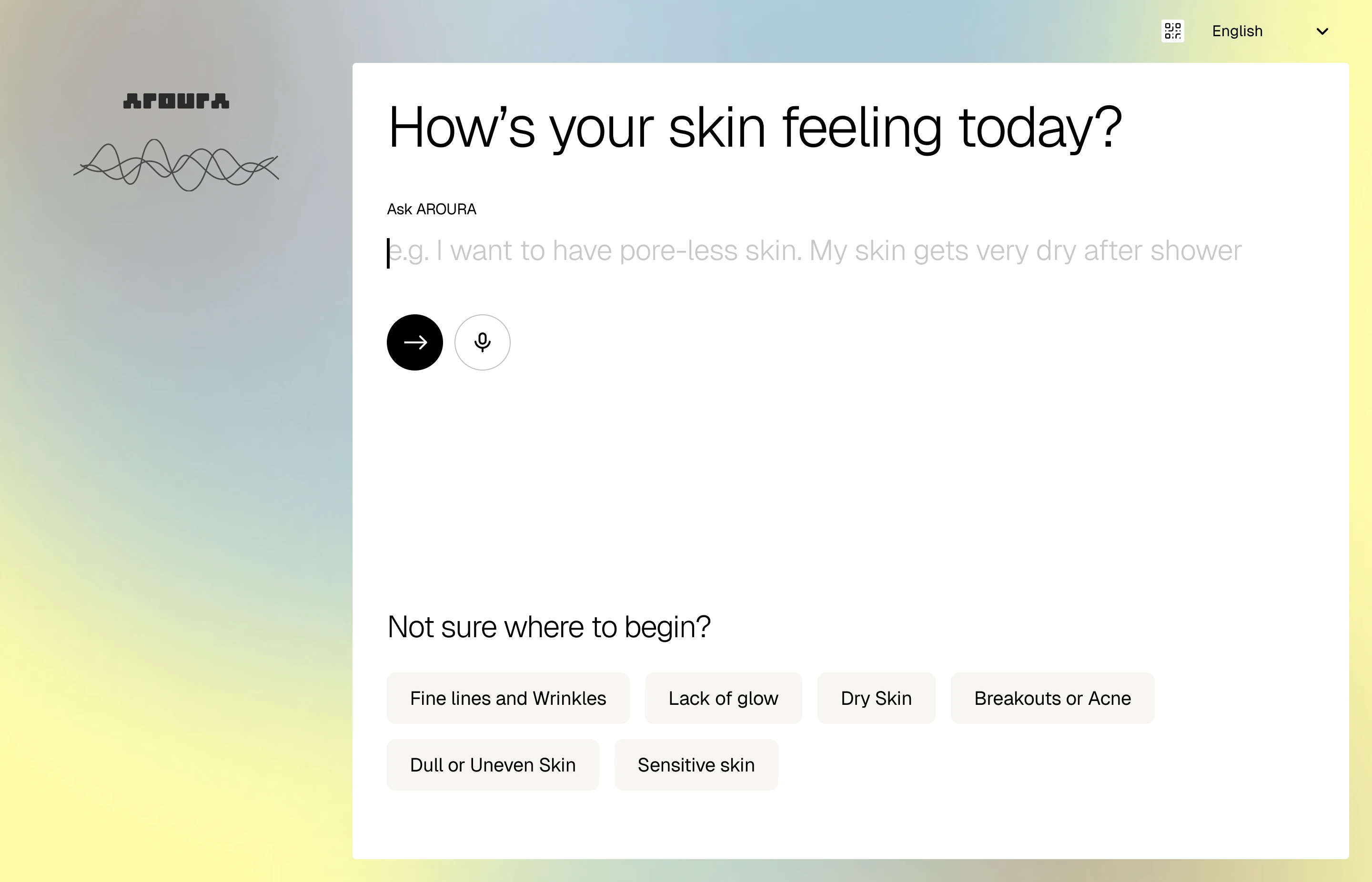
Where she starts depends on how she arrived.

Starts from what is already known and resolves only the context that could materially change the decision.

Hands overDecision-ready context
System 03Aroura AI
Ask only when the answer could change the recommendation.

Filters for eligibility, scores for relevance, re-ranks for preference and asks again only when uncertainty could change the result.

Hands overCandidates with reasons
System 04Brand + consumer
Recommendation learning

Turns recommendation-native interactions and consumer response into aggregated patterns brands can learn from.

Hands overAggregated market intelligence
System 05Brand research
Commissions a study

Separates brand-only research questions from recommendation logic and makes their purpose explicit to consumers.

Hands overLabelled, voluntary research
SYSTEMS 01–03Context becomes recommendation
SYSTEMS 04–05Response becomes learning
System · 01 · Brand

Brands verify the product record. They do not control ranking.

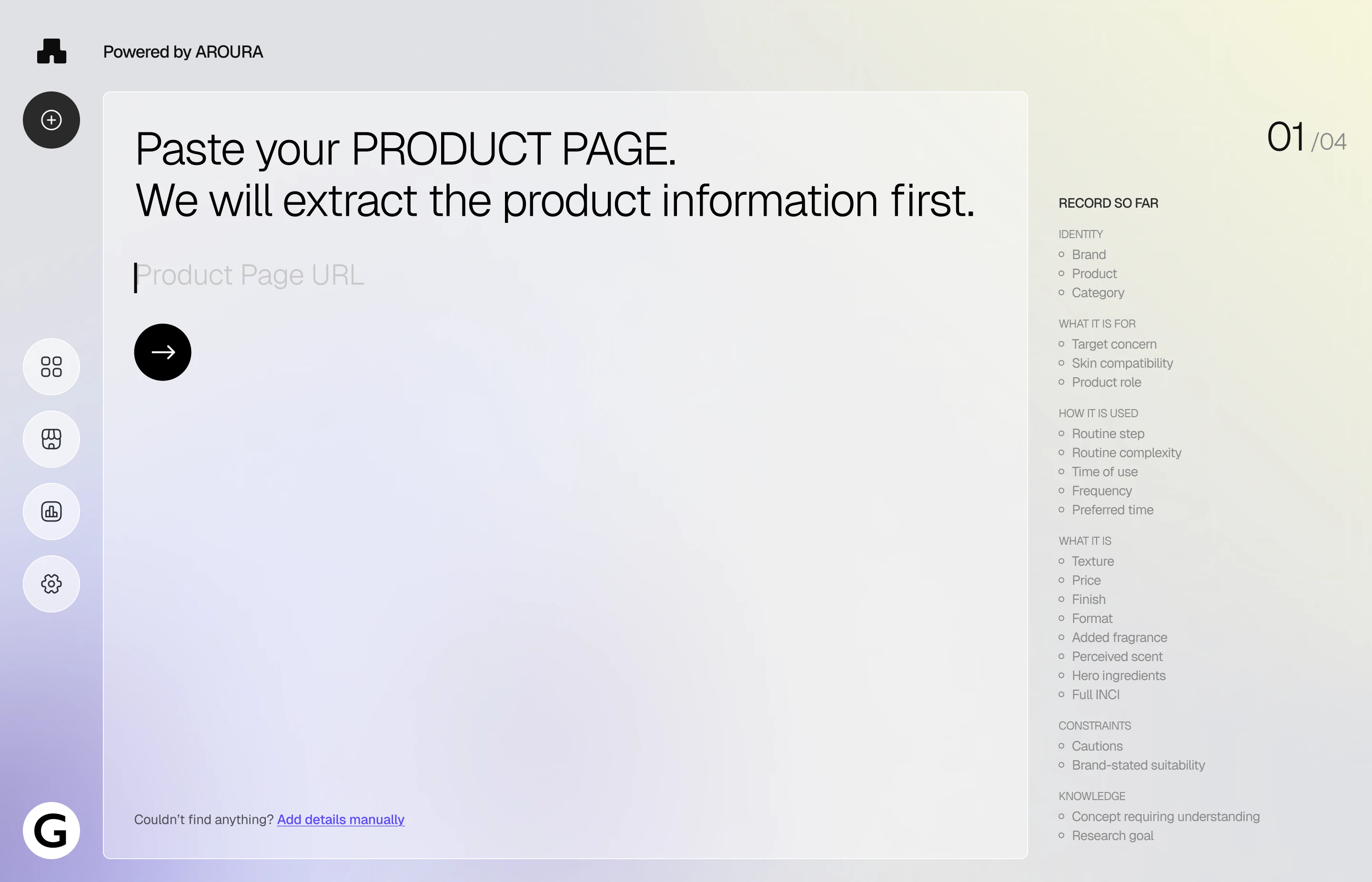
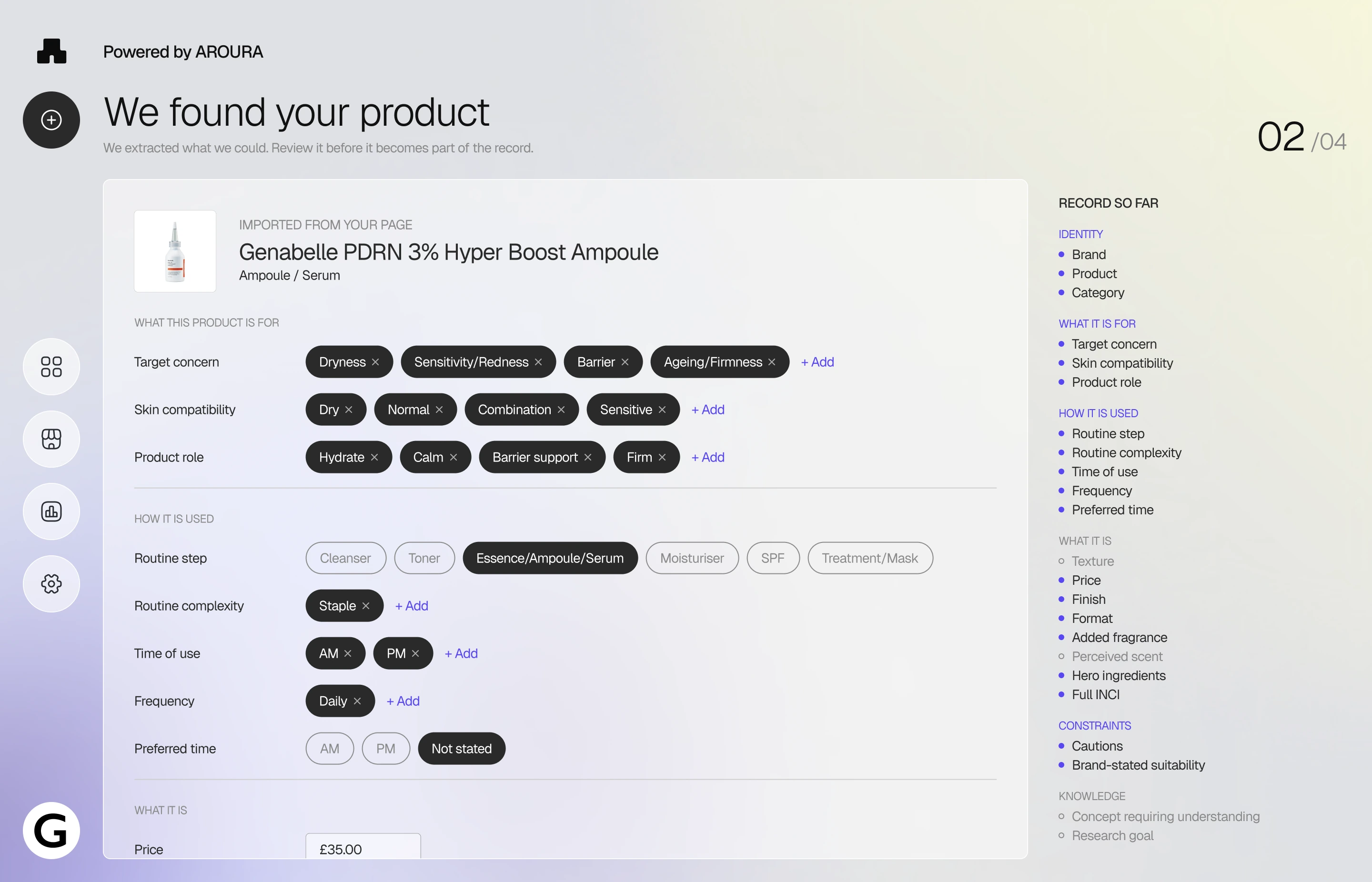
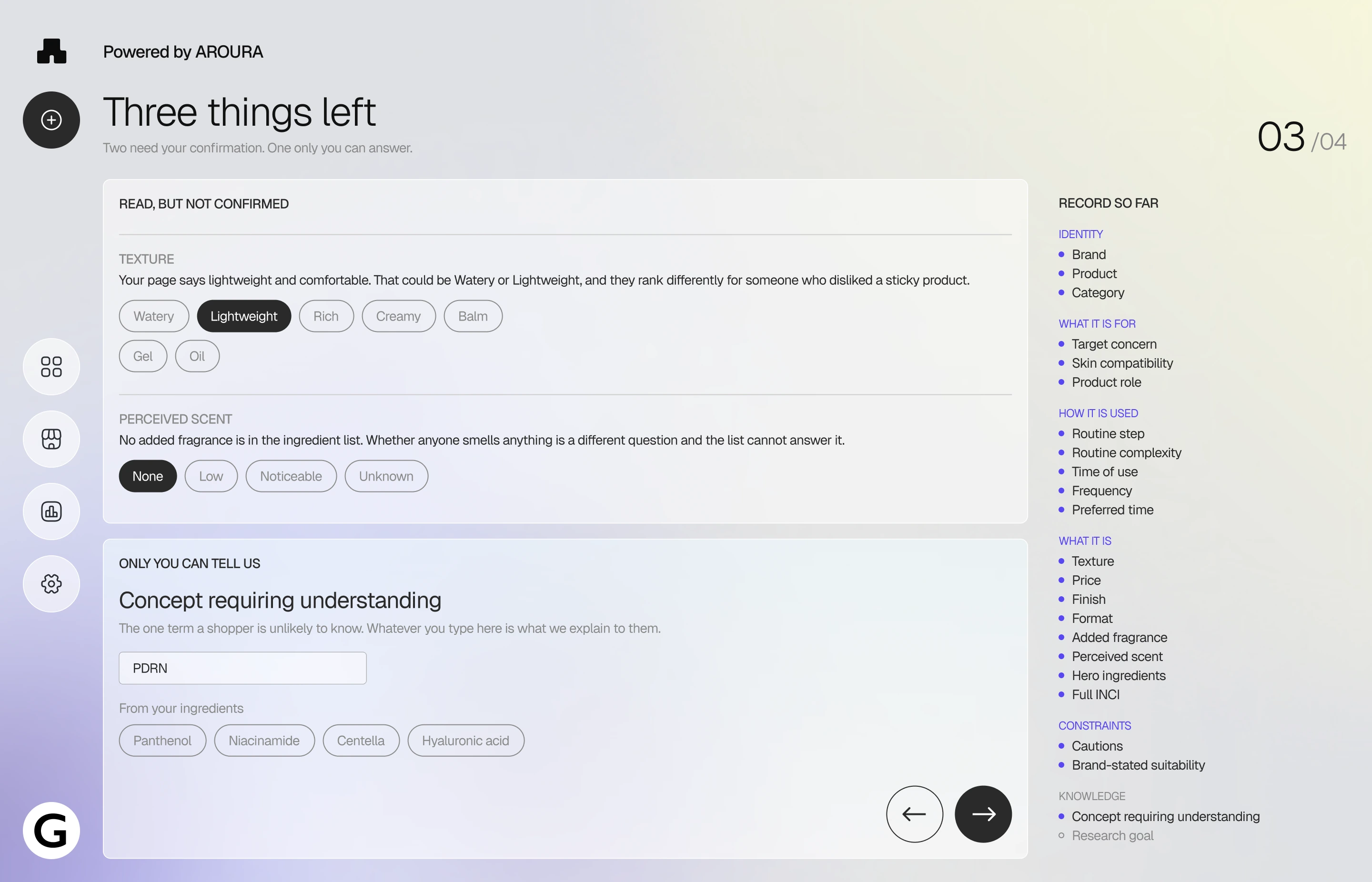
I designed registration to start with the product page a brand already had. AI extracts and normalises what it can; the brand only verifies consequential gaps the source cannot resolve.

The result is one comparable product record used by the recommendation system.

PRODUCT REGISTRATION
OPTIONAL NEXT ACTION

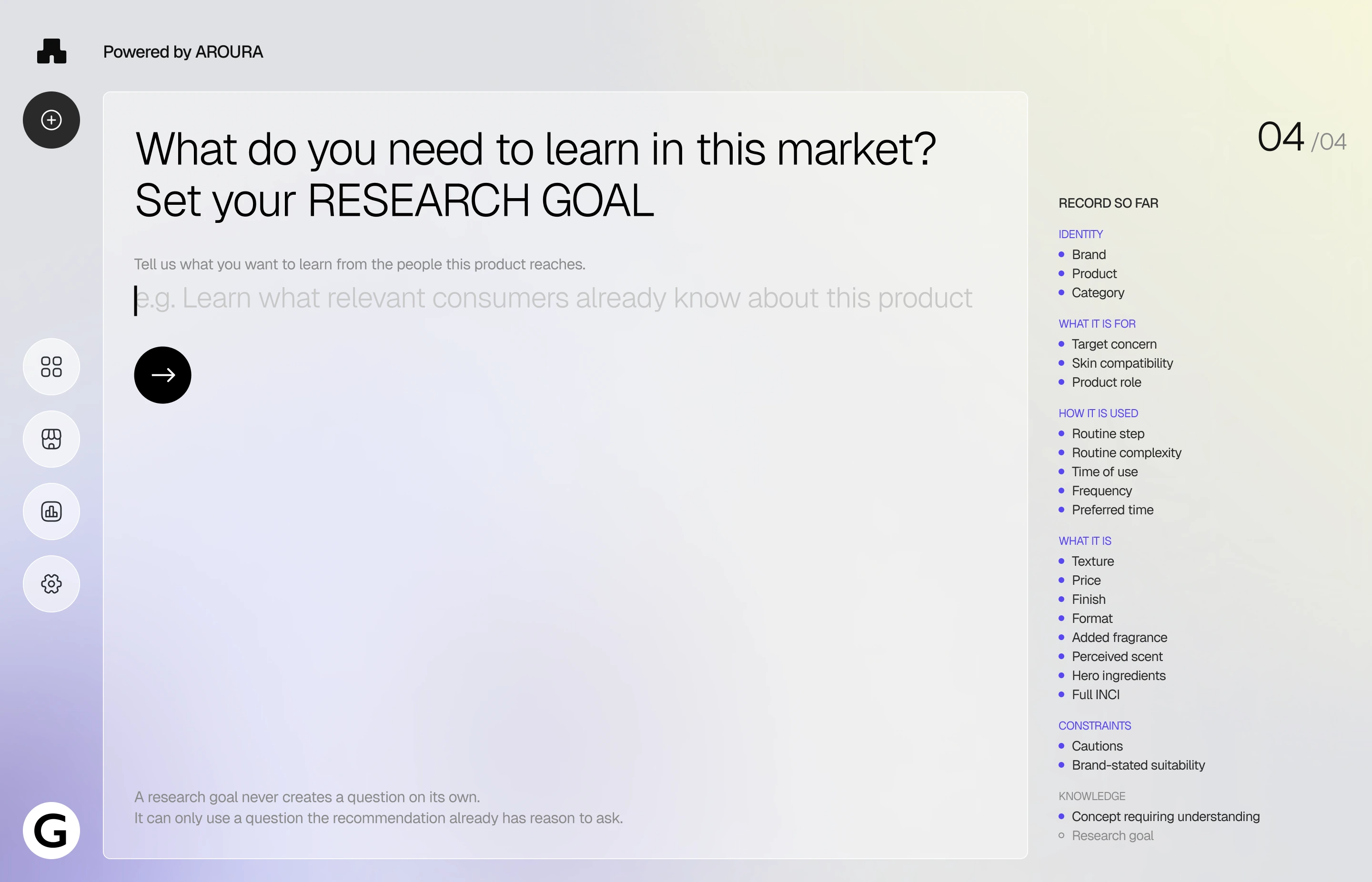
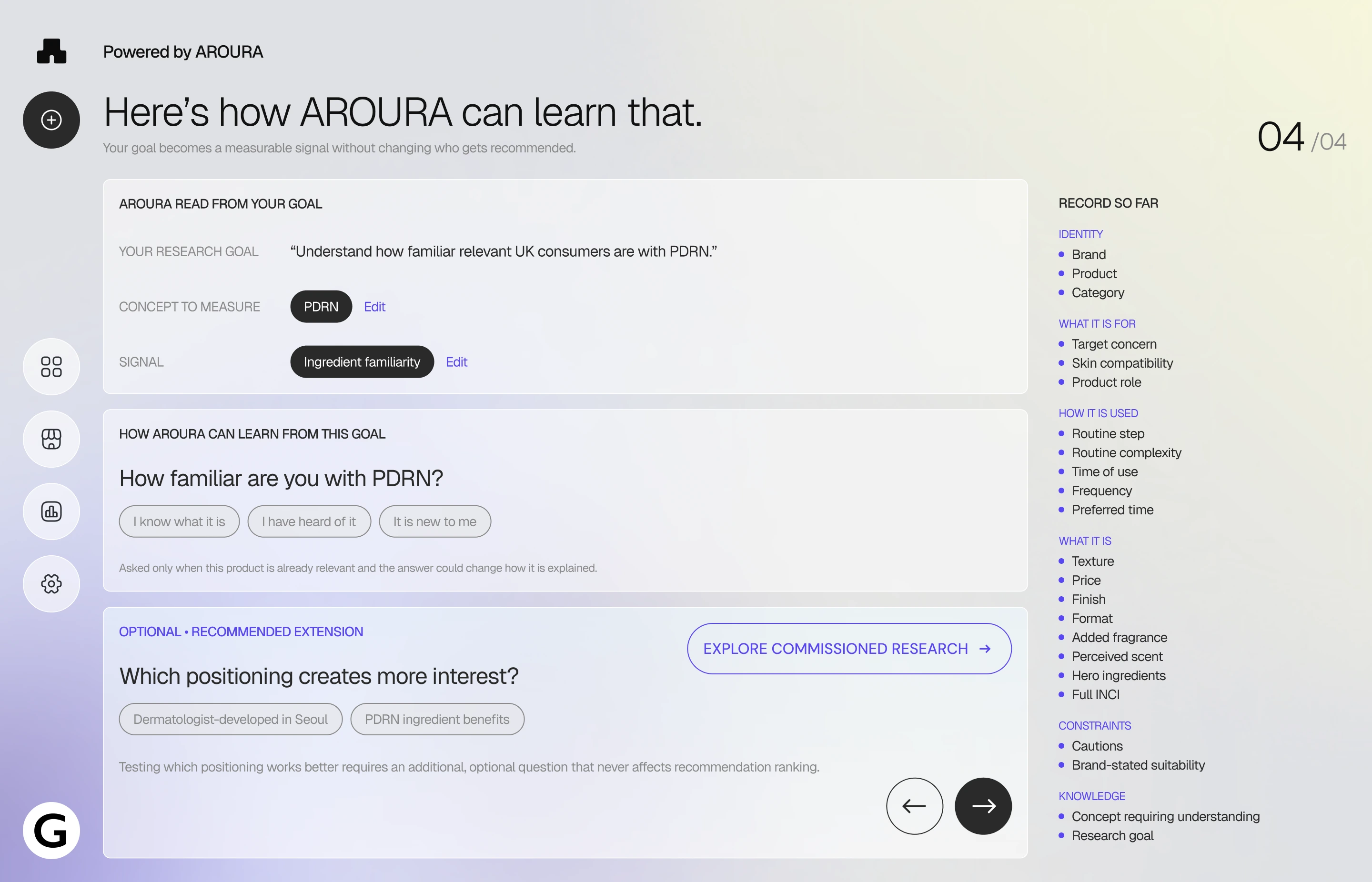
Research goals stayed separate from recommendation attributes.

Start with what already existsSee what the product page could answerResolve only what the extraction could notName what the brand needs to learnTurn the goal into a measurable signal
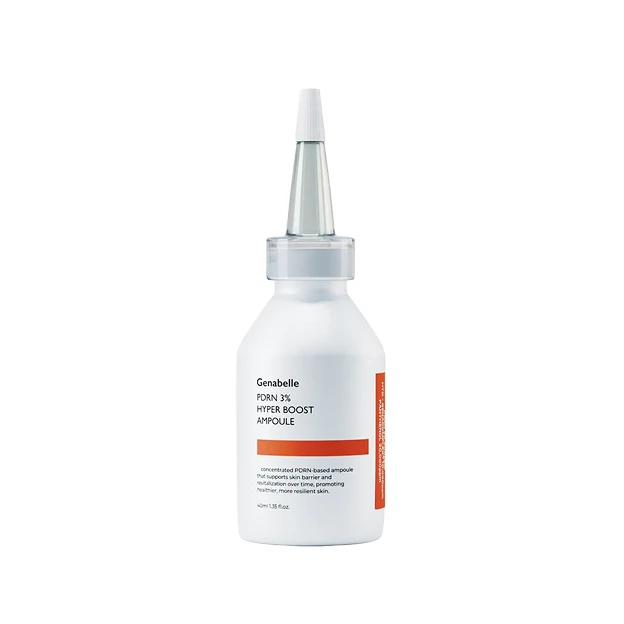
Genabelle PDRN 3% Hyper Boost, the product registered in the record below.
Genabelle PDRN 3% Hyper Boost
Fit
Experience
Formula
Knowledge
Concept requiring understandingPDRNExtracted, brand confirmed
Market familiarityUnknownAwaiting aggregated responses
Individual familiarityUnknownAwaiting consumer interaction
Explanation depthUnknownSet at runtime
System · 02 · Consumer

Where she starts depends on how she arrived.

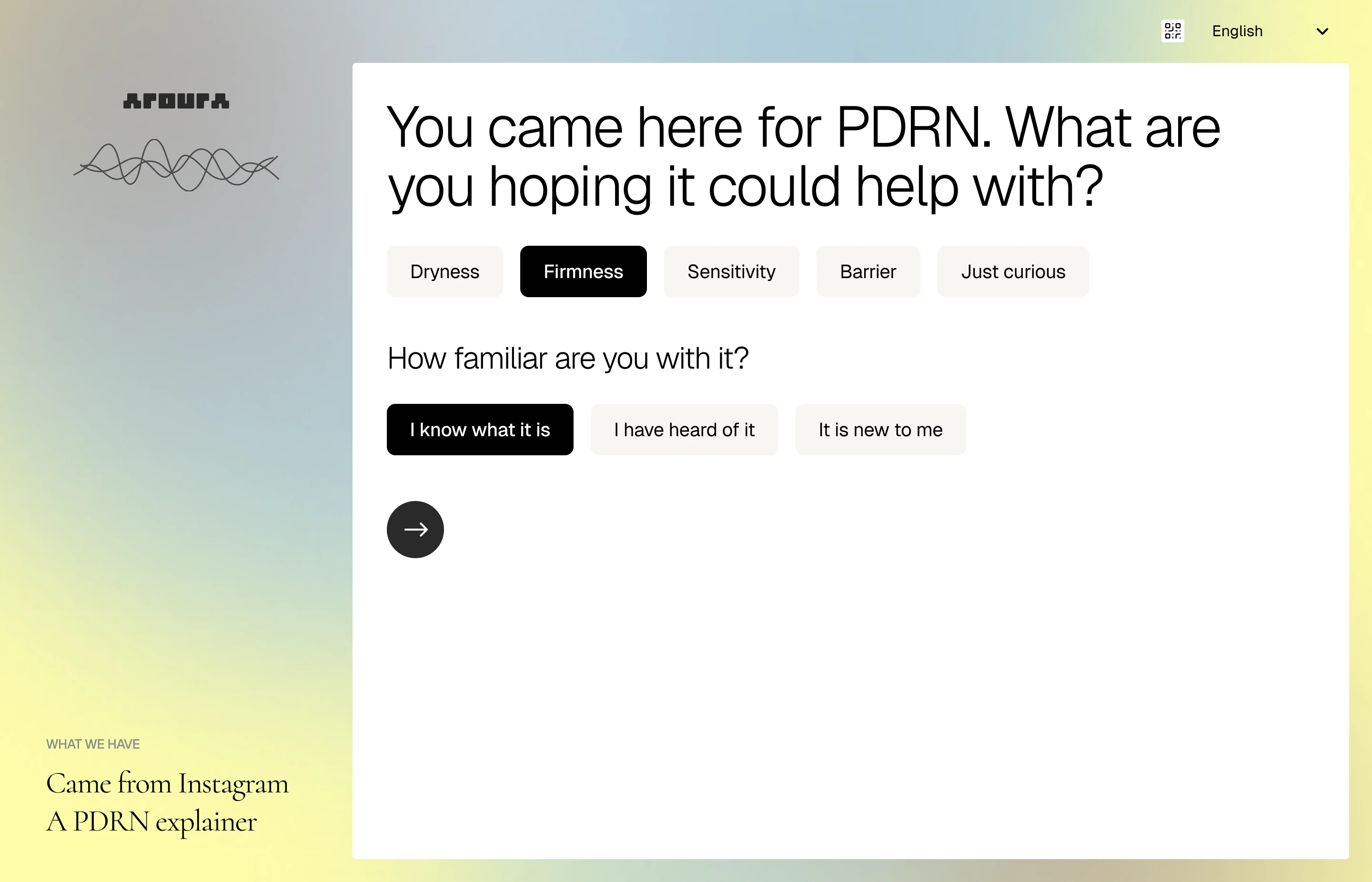
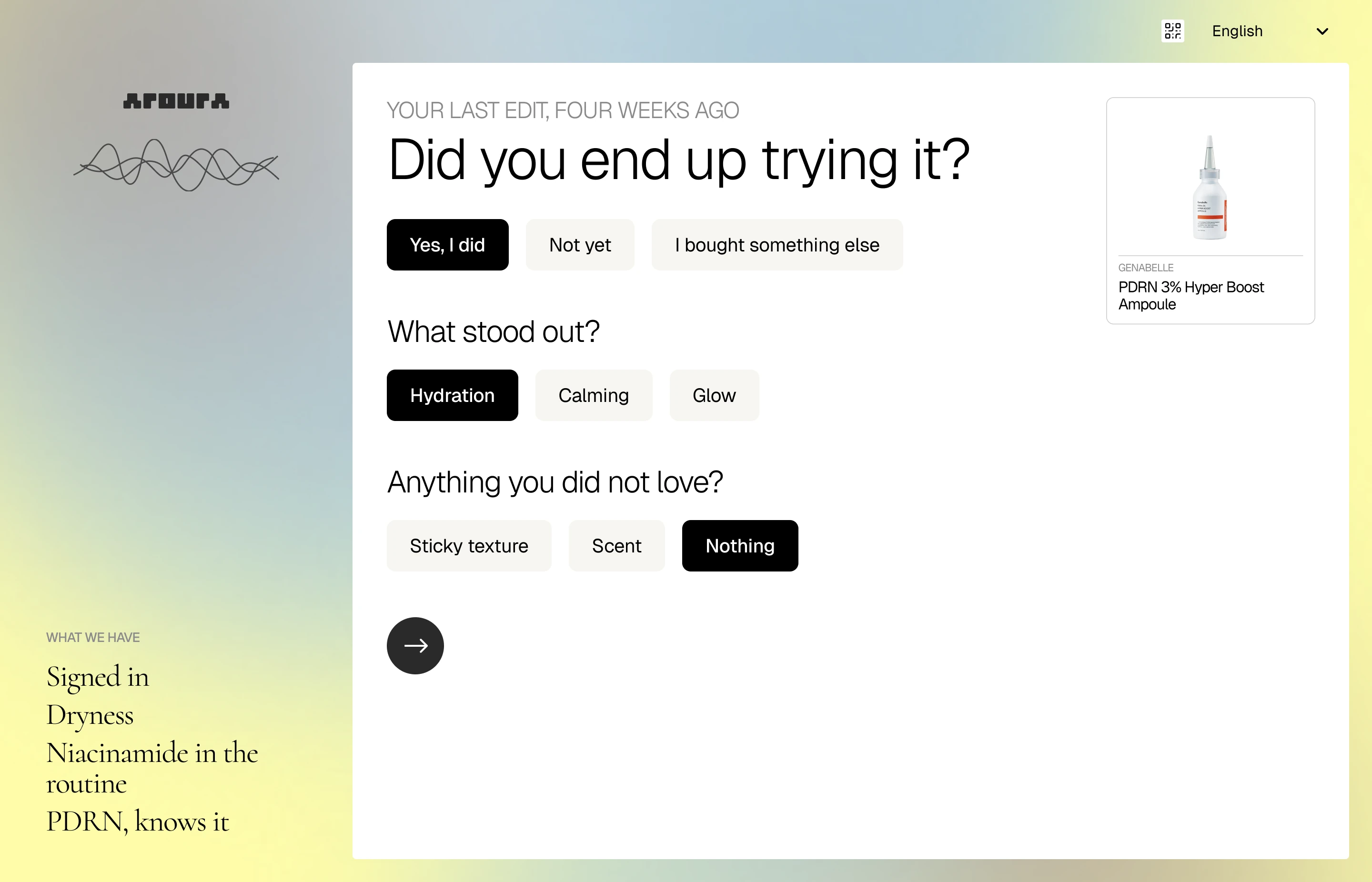
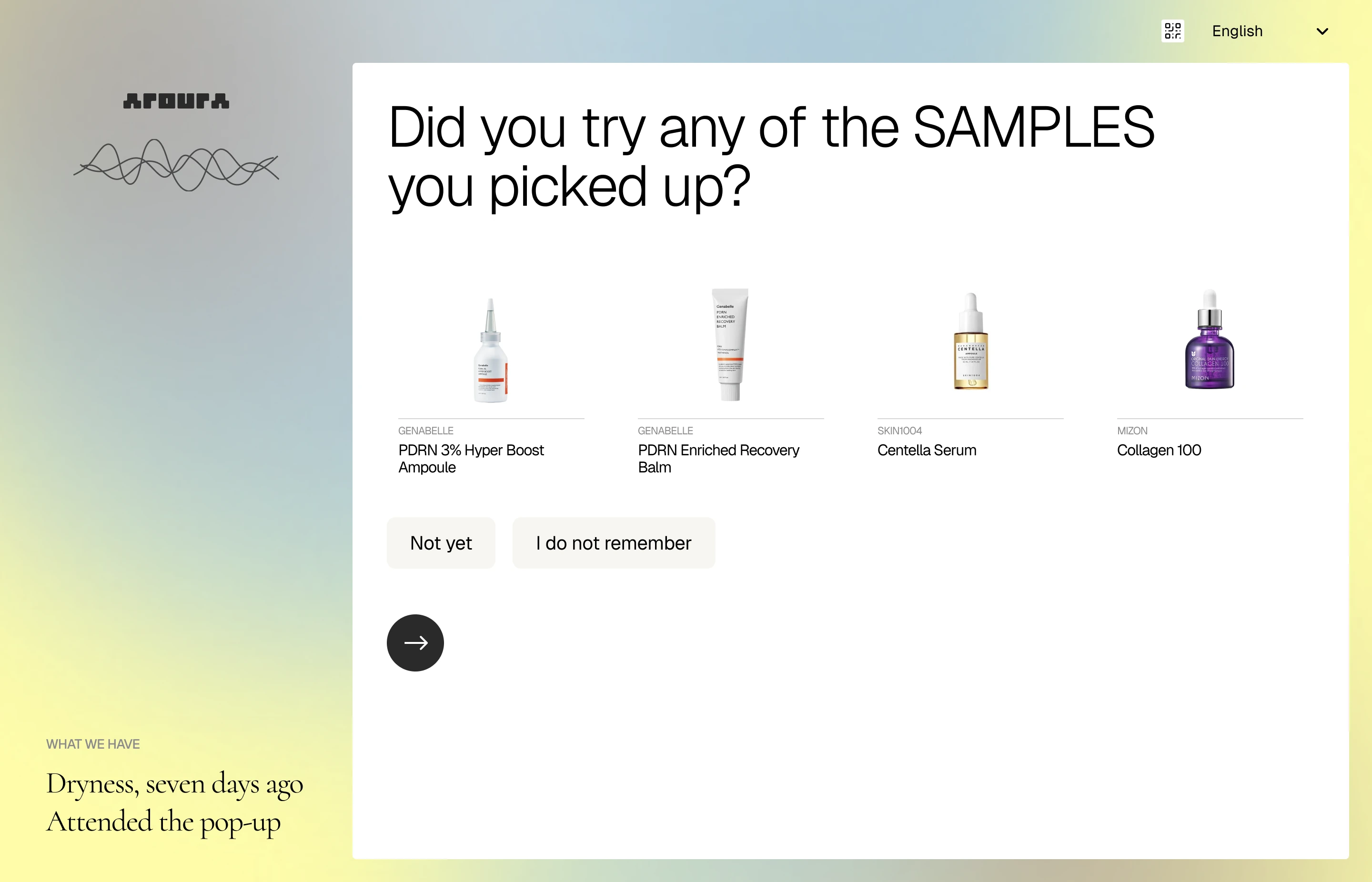
The system did not reset the consumer to zero at every entry. A returning customer, someone arriving from an Instagram post and someone we met at a pop-up would begin with different available context rather than the same questionnaire.

Seven independent signals rather than a list of user types. Types multiply, go stale, and never cover the person who arrives some other way. Signals compose, so a new channel is one new value.

STARTING STATE EXAMPLES
Signals
EntryDirect
AccountMissing
HistoryNone
DirectProduct linkReturningPop-up follow-up

Four states, four rules

I defined four states for every piece of consumer context, so the system could decide whether to use it, leave it open, confirm it or resolve it before asking another question.

Known
Use it.
Asking again is the fastest way to look like a form.
Missing
Ask, but only if it could change the recommendation.
A gap that changes nothing is not worth a screen.
Stale
Confirm it.
One question, already answered, needing only a yes.
Uncertain
Do not assume; resolve if consequential.
A wrong assumption costs more than an extra question.
Consumer context record
Context areaFieldValueState
IdentityAccountSigned inKnown
EntrySource / entry contextBTS pop-up follow-upKnown
NeedCurrent needDrynessKnown
Previous needDrynessStale
ConstraintsBudgetUnder £50Known
Product historySampled productAROCELL Cica Repair Panthenol Gel Mask SheetKnown
ExperienceOverall responseLiked some thingsKnown
Positive experienceHydrationKnown
Negative experienceSticky textureKnown
KnowledgeIngredient / concept familiarityMissing

Four states, and nothing else. How a value was arrived at, whether the person stated it, confirmed it or we inferred it, is kept as provenance rather than becoming a fifth state. Missing stays missing until an answer would change what gets recommended or how it gets explained.

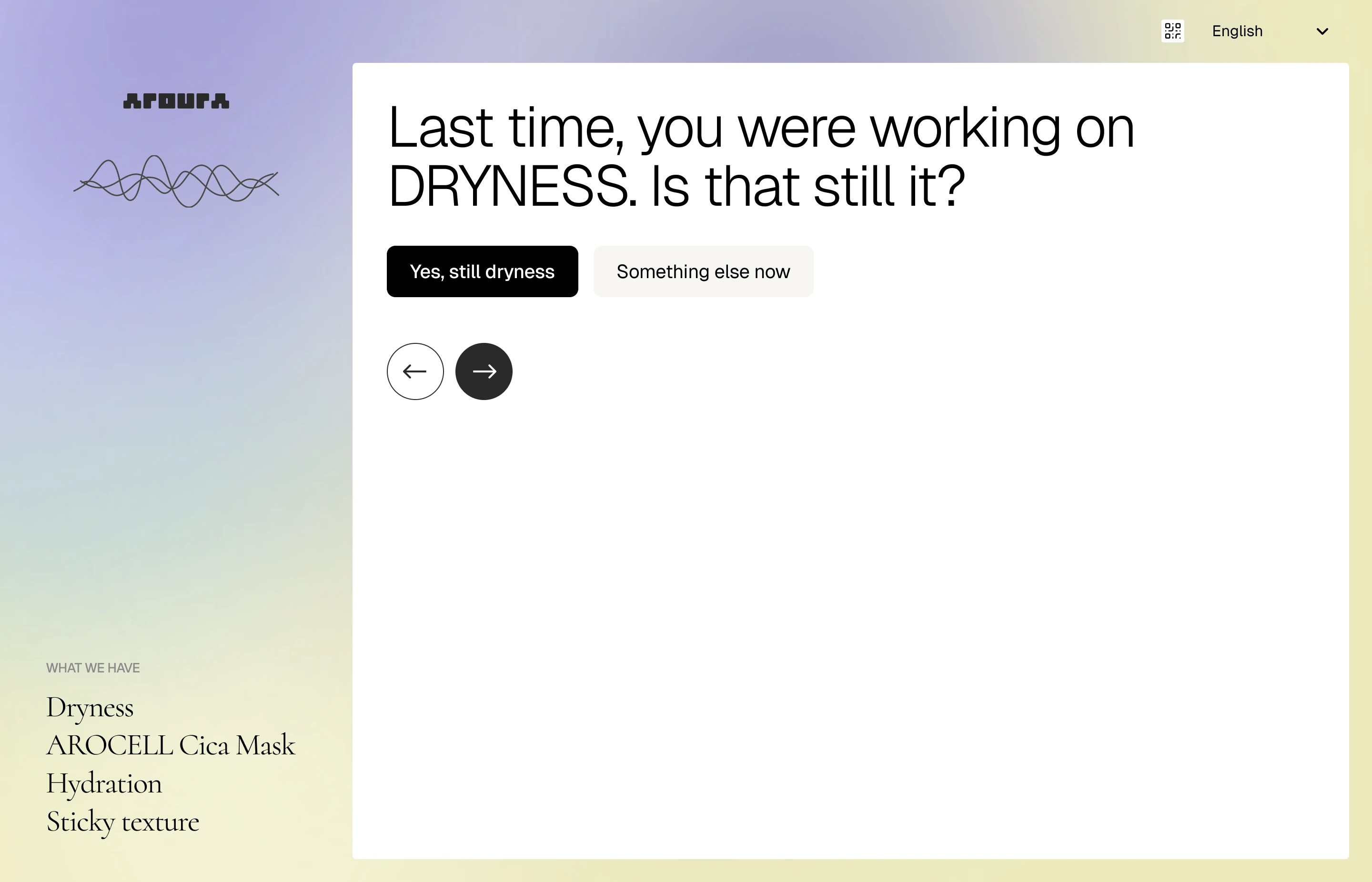
Skin is not a permanent profile

A stored answer is a fact about a moment, not a fact about a person. Someone who was oily and breaking out in March is not necessarily either in September, and a product that treats the old answer as current does not fail loudly. It quietly gets worse at the one thing it promised.

Confirm the need

It is a confirmation rather than a question, and that distinction is the whole of it. Telling someone what their skin is like costs the recommendation. Asking them costs one tap.

How long each answer is allowed to last

Only one field got confirmed on that screen, and that is deliberate. Nothing in the profile has a single lifespan: every field carries how long it is allowed to be trusted for, and that is what decides whether it gets reused silently, confirmed in one tap, or thrown out and asked again.

Held until contradicted
Long-lived
  • Ingredient familiarity
  • Strong dislikes
  • Known preferences
Someone who understood what PDRN was in March still understands it in September. Asking again reads as a system that was not paying attention.
Confirmed after a season
Medium-lived
  • Routine
  • Products currently used
Routines change, but not weekly. Worth checking after months rather than after days.
Assumed stale by default
Short-lived
  • Current concern
  • Irritation
  • Seasonal dryness
Skin in November is not skin in June. The most valuable field in the profile is also the one that goes off fastest.
System · 03 · Aroura AI

Ask only when the answer could change the recommendation.

I designed the engine to ask only when the available context no longer separated the useful candidates.

The engine compares resolved consumer context against products registered through the shared schema. It removes unsuitable products, ranks the remaining candidates by relevance and preference, then asks another question only when the answer could materially change the result.

Follow one person through the four stages below. Seven products enter with her context; the sequence shows what stays, what moves, what gets ruled out, and why.

01

Eligibility

Can I recommend it?

Start broad. A product only comes out when a known hard constraint makes it unsuitable.

Two things in her context could have removed something here and only one of them did. Under £50 is a hard constraint, so the d'Alba cream at £55.90 comes out even though it suits dryness and firmness better than most of what stays. Avoid sticky texture is a preference, so the Recovery Balm stays in. That difference is the whole reason this stage exists on its own. At seven products a budget cuts one. At three thousand it is the cheapest cut available, because price is the one field that does not correlate with any of the others.

What the person sees

The final ranking becomes an explained edit: viable candidates, clear reasons, and explanation depth adapted to what the person already knows.

The recommendation she receives

Designed to extend beyond the example

The sequence was specified around shared product fields, not rules written for these seven products. The same four stages were intended to hold as the catalogue grew; recommendation quality and performance at scale would still need validation.

System · 04 · Brand

A decline is evidence, not a lost sale.

The context consumers provide to improve their recommendation can also create useful learning for the brand.

I designed the system to aggregate those responses across relevant consumers, without exposing individual profiles or allowing brand learning goals to influence ranking.

ONE RESPONSEPDRN familiarity“New to me”CONSUMERExplanation AdaptsMore context about PDRNBRANDProduct LearningAggregated acrossrelevant consumers

What the proposed Genabelle view would show

Individual interactions become aggregated patterns around familiarity, resonance, rejection and post-trial response.

Who responded?Who it resonated with
What resonated?Which story earned attention
Why not?Why the rest did not
What happened after trial?After trial
The brand dashboard for Genabelle: market familiarity, decline reasons, which story earned attention, resonance, trial feedback and one commissioned research study.
Illustrative dashboard using scenario data, not live customer results. Percentages are paired with response counts so brands can judge the strength of the underlying evidence.

Research could inform a recommendation, but it could not buy one.

01
No fit, no research question.
If Genabelle is not already a legitimate candidate for this person, its question is never asked.
02
The answer has to help the person too.
A question that changes nothing about the recommendation or the explanation does not get asked during one.
03
Research never improves rank.
Wanting to learn something buys a brand no position. The ordering is decided before any of this runs.
04
One interaction is not a survey.
Only the highest-value question belongs in the decision. The rest waits for another interaction or for after trial.
COMMERCIAL EXTENSION

Deeper research stays separate from recommendation

Recommendation-native questions could create useful signals for brands, but some questions existed only to help the brand learn. I designed those as separate, commissioned studies for consumers to whom the brand or product was already relevant. Participation would be clearly labelled and optional, and neither payment nor response could affect recommendation relevance or ranking.

Brand setup
Consumer delivery
Brand output
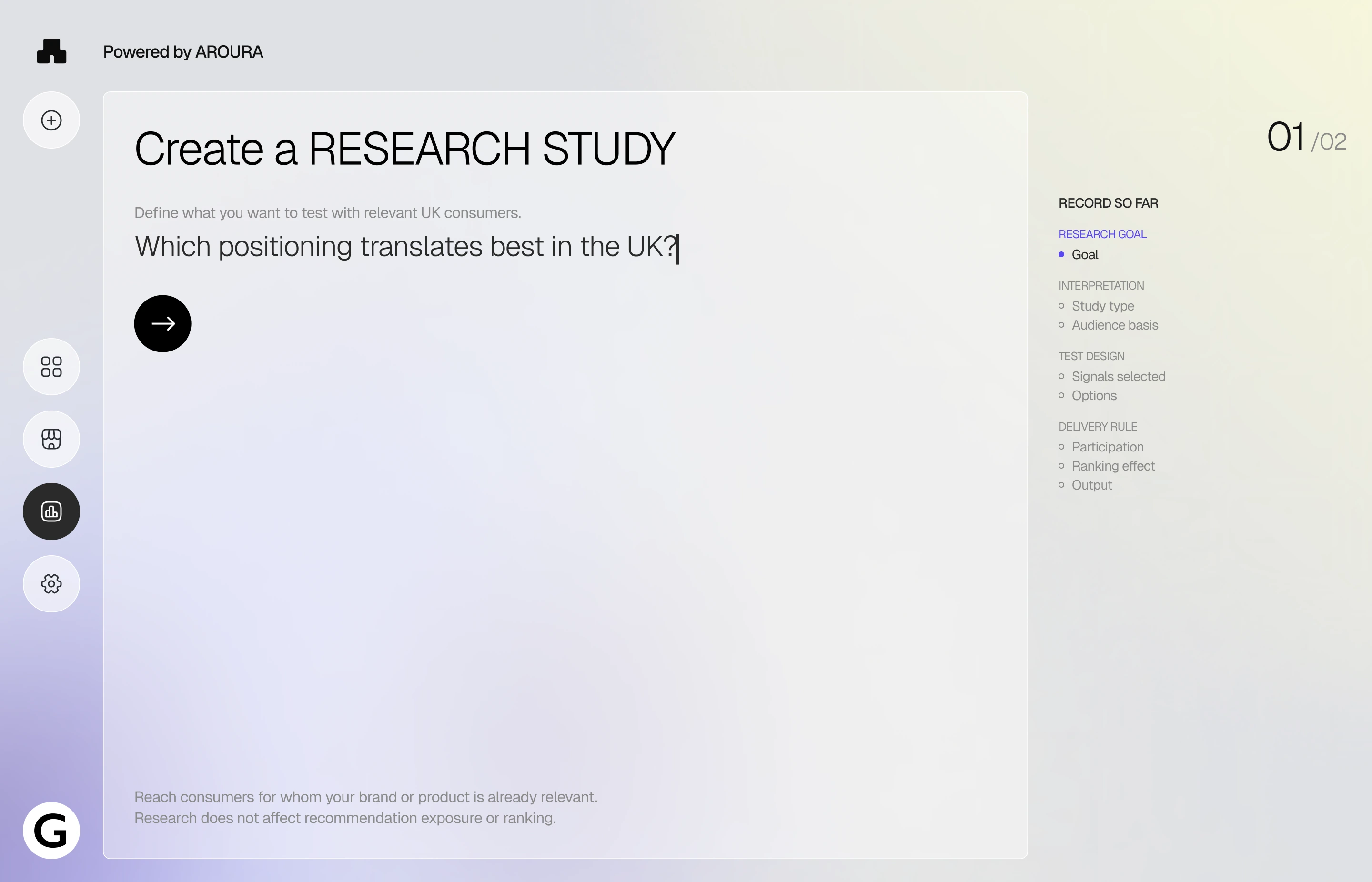
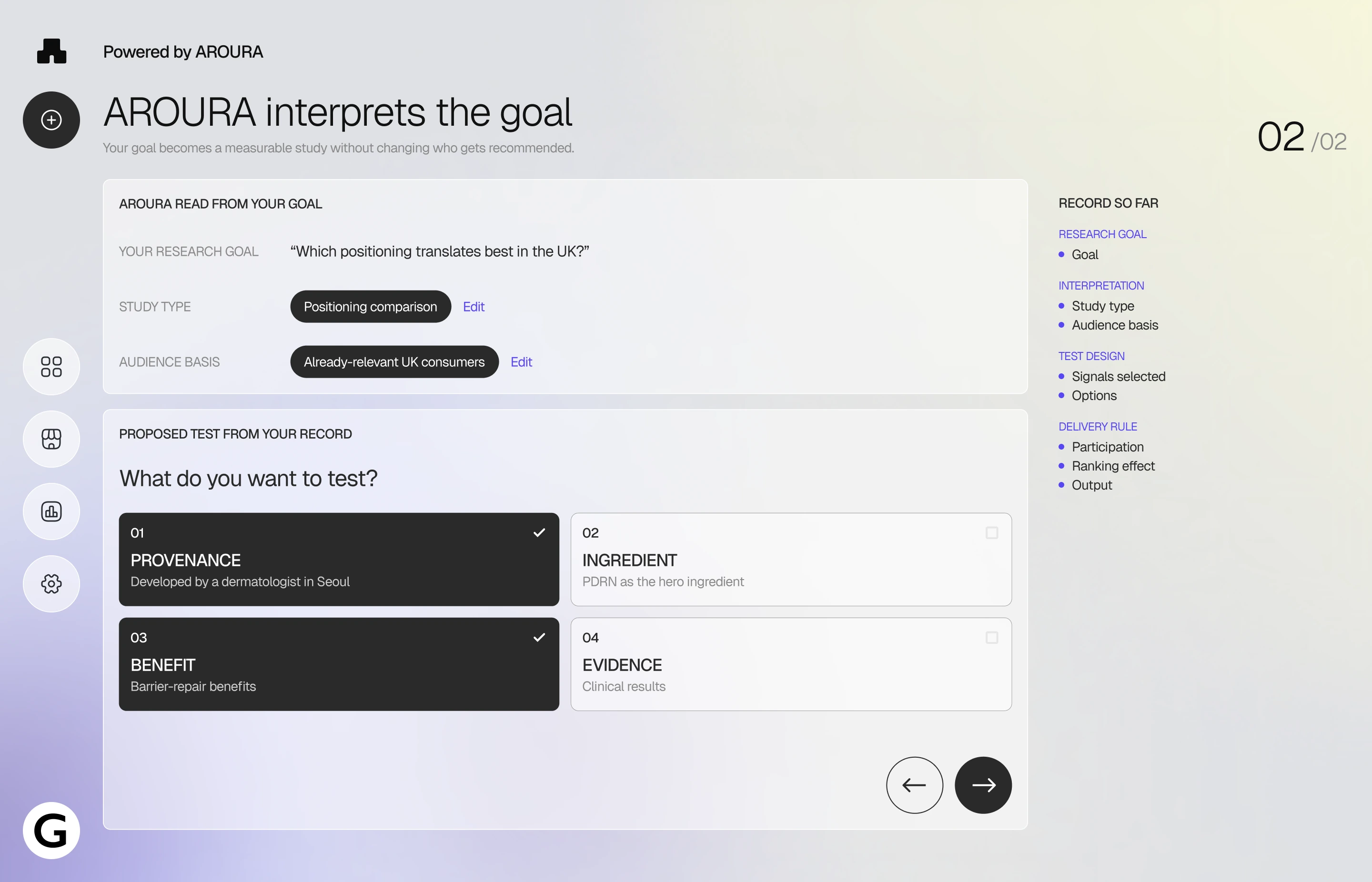
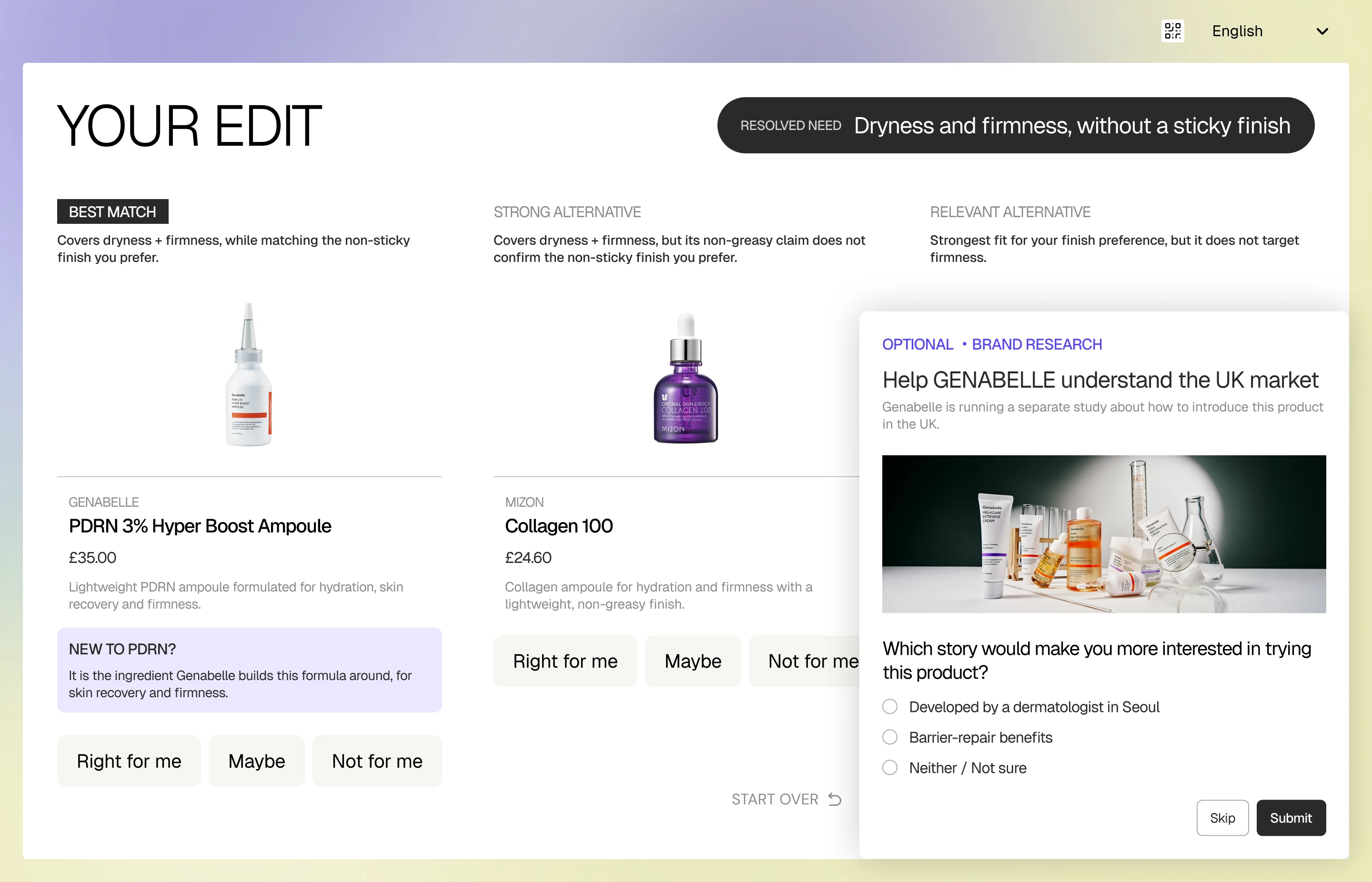
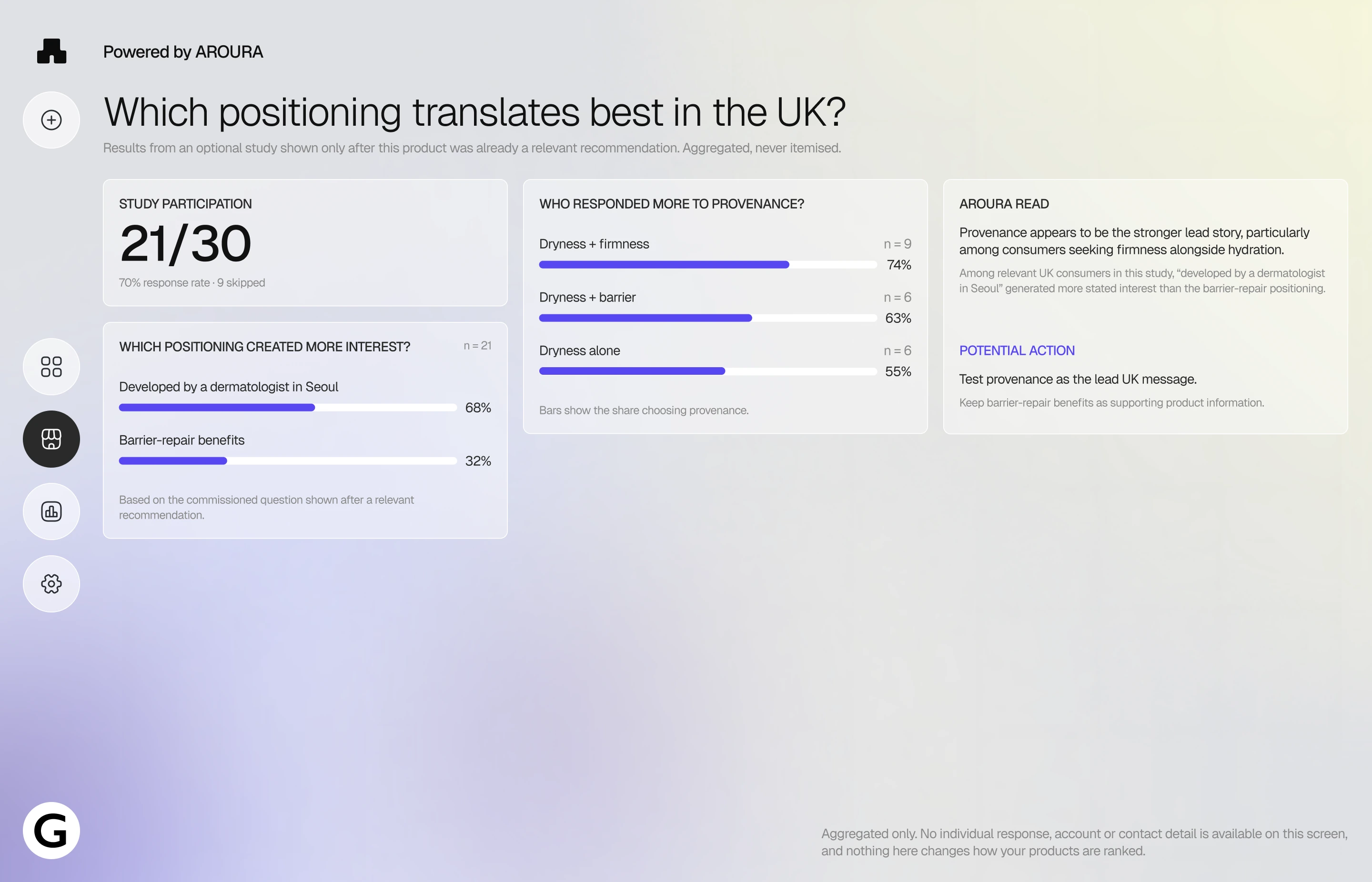
Step one of four: the brand writes the question it wants answeredStep two of four: the goal read back as a study type, an audience basis and the options to testStep three of four: the optional research study shown beside a recommendation it cannot changeStep four of four: the commissioned research dashboard showing aggregated responses and a suggested action
Once the recommendation interaction was complete, a separate, optional brand study could appear for consumers to whom the brand or product was already relevant.

Paying for research buys more questions, not more recommendation exposure.

In the proposed commercial model, payment would fund clearly labelled research rather than recommendation exposure. This preserved the boundary I wanted to test: brands could pay to learn from a relevant audience, but not to become more relevant to it.

MODEL BOUNDARY

Language work goes to the model. Decisions that have to be explained do not.

In the proposed architecture, no model would rank products. Open gaps would be calculated from the difference between the consumer record and the schema. To decide whether an answer could change what she sees, the system would try each allowed value and re-run the four stages. The controlled vocabulary was intended to keep that computation bounded, although implementation performance was not validated.

I assigned the model language tasks: proposing field values from a product page, normalising a brand's wording into the schema vocabulary, and drafting an explanation after the order was fixed. Consequential ranking decisions remained rule-based so they could be accounted for.

Where it landed

The product we set out to build, and the one I specified

WHERE WE STARTEDWHAT I DESIGNED NEXT
Problem
People cannot find the right products
Consumers struggle to evaluate unfamiliar products, while brands struggle to understand the consumers they are relevant to.
Value
Convenience
Relevant discovery for consumers; aggregated UK market learning for brands
What the AI does
Recommends products
Turns consumer context into relevant recommendations, and response into aggregated learning
What we research
A fixed research agenda defined by us
Recommendation-native learning, with separate commissioned research when brands need more
Where it lives
A kiosk at the event
One journey across the stand, the inbox and the phone
Who we serve
The consumer
Consumers directly, with brands as the proposed customer for aggregated market learning
What counts as success
A good recommendation
A useful consumer decision, plus market learning the brand can act on
WHAT REMAINS UNVALIDATED

What is still unanswered, and what I would validate next

The pop-ups provided evidence of the need and early demand signals, but not validation of the proposed product model. These are the four assumptions I would test next.

Recommendation quality

Do the proposed recommendations help people make a better choice than browsing alone, and are the reasons clear enough to trust?

Willingness to share context

Will consumers provide skin, routine and product-experience context when each answer visibly improves what they receive?

Trust in brand-related questions

Do consumers understand and trust the boundary between a question that improves their experience and research commissioned by a brand?

Brand willingness to pay

Which aggregated insights would brands fund, which decisions would they use them for, and at what price?

The lesson was not about AI

I joined an early-stage company believing the hard part of an AI product was the experience: how it asks, explains and recovers. A year of building useful experiences without a clear path to adoption taught me that experience quality was only one part of the product question.

Across three product directions, the most consequential gaps sat beyond the interface: structured data underneath the experience, a brand with a reason to pay for the value it received, and trust between the parties the product was meant to connect.

It changed where I start: with who creates value for whom. Everything on the screen is downstream of that answer.